


Massage for sciatica: Simple Techniques for Relief
Absolutely. That sharp, shooting pain that runs from your lower back down your leg is a tell-tale sign of sciatica, and it can be completely debilitating. The good news is that specialized massage for sciatica can be an incredibly effective, non-invasive way to find real relief.
It works by directly targeting the tight muscles—often deep in your glutes and lower back—that are pinching the sciatic nerve. By releasing that pressure, we can get to the root of the radiating pain, numbness, and tingling.
How a Good Massage Actually Helps Sciatica
Think of your sciatic nerve as a major electrical cable running from your lower spine all the way down to your feet. Sciatica happens when something compresses or irritates that cable, disrupting the signals and causing that unmistakable pain. It isn't a condition on its own, but a symptom of an underlying problem, like a tight muscle or a bulging disc.

This is where a skilled Registered Massage Therapist (RMT) comes in. Our job is to play detective, figuring out exactly which muscles are causing the compression. The goal isn't just to rub the spot that hurts; it’s to strategically release the specific muscle tension that’s pinching that "cable."
Let's take a quick look at how targeted therapeutic massage addresses the main symptoms of sciatic nerve pain.
Common Sciatica Symptoms and How Massage Helps
Common Sciatica Symptom | How Therapeutic Massage Provides Relief |
|---|---|
Sharp, shooting pain down one leg | Relieves muscle tension (e.g., in the piriformis) that directly compresses the sciatic nerve, calming the source of the pain. |
Dull, aching lower back pain | Eases tightness in lumbar and gluteal muscles, which improves pelvic alignment and reduces strain on the nerve pathway. |
Numbness or tingling ("pins and needles") | Boosts blood circulation to the affected areas, helping to restore normal nerve function and sensation. |
Muscle weakness in the leg or foot | Releases trigger points and restores proper muscle function, allowing for better activation and strength. |
By working on these issues, an RMT doesn't just offer temporary relief—we help correct the underlying mechanical problems.
Pinpointing the Real Culprit Behind Your Sciatic Pain
One of the most common culprits is a small but mighty muscle deep in your buttocks called the piriformis. When it gets tight or goes into spasm, it can clamp down directly on the sciatic nerve. This specific issue is often called piriformis syndrome, and a focused massage for sciatica can work wonders by releasing this muscle and freeing the nerve.
But the piriformis isn't always the only muscle involved. An experienced RMT will look at your entire body's interconnected chain of movement, assessing other key areas like:
Gluteal Muscles: Tension here is a very common contributor to direct nerve compression.
Lower Back Muscles: A tight lower back can tilt your pelvis out of alignment, which indirectly puts stress on the sciatic nerve.
Hamstrings: Chronically tight hamstrings can pull on the pelvis, making lower back and sciatic problems much worse.
By addressing all these related areas, therapeutic massage moves beyond just chasing symptoms. It works to fix the source of the problem. This holistic approach is a core principle of effective treatment, and you can learn more by exploring what Registered Massage Therapy is and how it can help you.
Your Path to Relief, Right in Your Own Home
If you live in Brampton, Toronto, Etobicoke, Oakville, Caledon, Orangeville, Mississauga, Milton, Halton, or Guelph, getting this kind of specialized care is easier than ever. Taylor, our male RMT at Stillwaters Healing & Massage, brings professional, therapeutic sessions directly to you. This in-home mobile service means you don't have to deal with the stress and discomfort of travelling to a clinic when you're already in pain.
Being treated in your own familiar, comfortable space allows your body and nervous system to fully relax. This makes the therapy far more effective and lets you transition seamlessly from the massage table to a state of rest, maximizing all the benefits of your session.
Ultimately, massage for sciatica is about giving you back control over your body and your life. It’s a personalized, hands-on approach that calms the irritated nerve, restores healthy muscle function, and sets you on a path to becoming more active and pain-free.
How Massage Therapy Calms an Irritated Sciatic Nerve
To get a handle on how therapeutic massage for sciatica can help, it's useful to think of your body's pain system as a fire alarm that's stuck blaring. When your sciatic nerve gets irritated, the muscles around your lower back, glutes, and legs instinctively tighten up to guard the area. The problem is, this constant muscle guarding often backfires, squeezing the already angry nerve even more and locking you into a painful cycle.
Therapeutic massage is all about interrupting that cycle. It’s not just about rubbing a sore spot; it’s a targeted approach designed to manually flip the "off" switch on that alarm, addressing both the pain you feel and the irritation causing it.
This relief comes from a few key things happening in your body at once.
Boosting Circulation and Reducing Inflammation
Chronically tight muscles don't get good blood flow. Picture a traffic jam on a major highway—nothing gets in, and nothing gets out. Nutrients and oxygen can't reach the tissues, and metabolic junk like lactic acid gets stuck, creating an inflammatory soup that irritates the nerve.
Massage therapy essentially acts as a traffic controller, physically manipulating the soft tissues to clear the congestion.
Improved Blood Flow: The pressure and movement from the massage techniques encourage fresh, oxygen-rich blood to flood into those tense muscles, bringing the nutrients needed for repair.
Waste Removal: At the same time, this boost in circulation helps flush out the inflammatory byproducts that have been building up and contributing to your pain.
By improving this circulatory exchange, massage helps dial down the chemical irritation around the sciatic nerve, giving it the space it needs to calm down and heal.
Triggering the Body’s Natural Pain Relief
Your body has its own built-in pain-relief system, and a good massage therapist knows how to tap into it. The sustained, rhythmic pressure applied during a session sends signals through your skin and muscles straight to your brain, telling it to release some powerful, feel-good chemicals.
Endorphins, often called the body's natural painkillers, are released in response to massage. These neurochemicals have a morphine-like effect, effectively turning down the volume on pain signals and bringing on a sense of well-being and deep relaxation.
This is why you often feel that immediate, soothing relief during and after a session. It’s a natural, drug-free way to manage the sharp, radiating pain of a sciatica flare-up. This effect isn't just a temporary fix; it also helps quiet the entire nervous system, making it easier for those clenched muscles to finally let go.
Releasing the Muscular Source of Compression
Finally, and most critically, massage directly tackles the mechanical problem: the tight muscles physically squeezing the sciatic nerve. Your RMT, Taylor, uses specialized techniques to hunt down and release the exact muscles responsible for the compression.
This often means working on deep muscles like the piriformis and the glutes, which sit directly on top of the sciatic nerve's pathway. Using focused pressure, your therapist can manually break down muscle knots and adhesions. These knots, known as trigger points, are notorious for referring pain down the leg in a pattern that perfectly mimics sciatica. By relaxing these key muscles, the physical pressure is taken off the sciatic nerve, allowing it to function without being aggravated. This is the foundation of an effective massage for sciatica—it’s not just about managing symptoms, but about getting to the root of the problem.
5 Key Massage Techniques That Can Tame Sciatic Pain
When you’re wrestling with the sharp, radiating pain of sciatica, a standard relaxation massage just isn't going to get the job done. To get real relief, you need a targeted approach that zeroes in on the specific muscles and tissues squeezing the sciatic nerve. An experienced Registered Massage Therapist (RMT) like Taylor comes equipped with a whole toolkit of specialized techniques, each one designed to calm that irritated nerve and help you move freely again. Our services include Swedish massage, Cupping therapy, Deep tissue massage, Rehabilitation massage, Myofascial release, Trigger point release, Joint mobilization, Hydrotherapy applications, Geriatric massage, Sports massage therapy, and even Energy healing.
Let's break down some of the most effective massage techniques for sciatica.
Deep Tissue Massage
Think of the muscles around your sciatic nerve path like a tight, tangled bundle of ropes. When they're all knotted up, they can pull your alignment out of whack and put a chokehold on the nerve. Deep Tissue Massage is the technique we use to patiently untangle those ropes. It involves slow, firm strokes and focused, sustained pressure to reach the deeper layers of muscle and connective tissue.
The point isn't to cause pain, but to apply just the right amount of pressure to break down adhesions—those rigid, painful bands of tissue. Adhesions often form in muscles from old injuries or chronic tension, and they are a major culprit in nerve compression. By releasing them, we bring back flexibility and take that direct pressure off the sciatic nerve. To learn more about this powerful modality, check out our guide to deep tissue massage for pain relief.
Myofascial Release
Your muscles don't exist in a vacuum; they're all interconnected and wrapped in a thin, strong webbing of connective tissue called fascia. The easiest way to picture it is like a single, body-wide stocking that holds everything in place. If this fascial web gets tight or stuck in one area—say, your lower back or hips—it can create a pull on other parts of your body and even trap nerves, a bit like a snag in a sweater.
Myofascial Release is a gentle yet profound technique that uses sustained, stretching pressure to coax the fascial system into letting go. Taylor will use this method to carefully and slowly lengthen those restricted tissues, freeing up the sciatic nerve from its fascial prison. The aim here is to restore the natural glide and movement between your muscles and fascia, which stops the pulling and compression that fuels sciatic pain.
Trigger Point Therapy
Sometimes, the real source of sciatic-like pain isn't the nerve itself, but a tiny, angry spot in a muscle known as a trigger point, or "knot." These little knots are notorious for sending pain to other parts of the body in very specific patterns. For instance, a trigger point in the piriformis or gluteus minimus muscle can shoot pain right down the leg, perfectly mimicking classic sciatica.
Trigger Point Therapy is precision work. It involves applying direct, steady pressure to a specific knot until it finally "releases" or softens. This deactivates the trigger point, which in turn cuts off the referred pain signals and can bring surprisingly immediate relief from that radiating leg pain.
This technique is like finding the master switch for the pain alarm and flicking it off. It’s a vital part of a comprehensive massage for sciatica because it directly tackles those muscular culprits that can cause so much trouble.
By layering these different approaches, your RMT can build a treatment that addresses your sciatic pain from all angles—from the deep muscle adhesions and superficial fascial restrictions to the tricky trigger points sending pain signals down your leg.
Crafting Your Personalized Sciatica Recovery Plan
When you're dealing with sciatica, a generic, one-size-fits-all approach just won't cut it. The truth is, your path to relief is as unique as you are. A truly effective treatment plan needs to be built around the specific muscles causing your pain, your daily habits, and your overall health.
Your journey starts with a thorough assessment. When your RMT, Taylor, arrives for that first in-home session, the goal isn't just to chase the pain. It’s to uncover its origin story. This deep dive is the cornerstone of a plan that targets the root cause of your sciatica, not just the symptoms.
The Initial Assessment: Your Foundation For Success
The first step is always a detailed chat about your health history and what you've been experiencing. Taylor will want to know everything—where the pain is, how intense it gets, and what activities make it better or worse.
From there, we move into a physical assessment, which might look something like this:
Postural Analysis: Just observing how you naturally stand and sit can reveal subtle imbalances that put pressure on the sciatic nerve.
Range of Motion Testing: We'll gently guide your hips and lower back through various movements to pinpoint exactly which ones trigger your pain.
Palpation: By carefully feeling the muscles around your lower back, glutes, and down your leg, we can find those notorious trigger points and areas of deep-seated tension.
This isn't just a formality. For our clients across Oakville, Caledon, and the Halton region—especially older adults who may have other health concerns—this careful, considered approach is non-negotiable. It’s all about creating a plan that is both safe and effective for you.
Mapping Out the Phases of Your Treatment
A smart recovery plan isn't static; it evolves as your body heals. Think of it as a collaborative journey that we take together, moving from putting out the fire to building long-term resilience. Your treatment will likely unfold in a few distinct phases, each with a clear purpose.
A personalized plan is your roadmap. It guides you from being stuck in a cycle of acute pain and limited movement to a place of strength, flexibility, and freedom. Each session intentionally builds on the last, ensuring you're always moving forward.
First, we focus on calming the storm. The initial goal is simply to get the pain and inflammation down to a manageable level. This is where we use techniques to release the tightest, most problematic muscles to provide that much-needed immediate relief and break the pain cycle.
Once your symptoms start to ease up, our focus shifts from firefighting to rebuilding. In this next phase, we concentrate on restoring your body's normal movement patterns. We’ll work on improving flexibility in your hips and lower back and address any secondary muscle tightness that cropped up while your body was compensating for the pain.
The image below shows how different techniques can be layered throughout your treatment plan, moving from broader work to more specific, targeted therapy.

As you can see, we might start with deep tissue work to warm up and release the larger muscle groups, paving the way for more precise myofascial and trigger point techniques that get right to the heart of the problem.
Here’s a sample breakdown of what a treatment plan might look like over several sessions.
Sample Sciatica Treatment Plan Phases
Treatment Phase | Session Focus | Primary Techniques Used |
|---|---|---|
Phase 1: Pain & Inflammation Reduction (Sessions 1-3) | Decrease acute pain, reduce muscle guarding, and calm the nervous system. | Gentle Myofascial Release, Positional Release, Hydrotherapy (heat/cold), Gluteal and Piriformis work. |
Phase 2: Restoring Mobility & Function (Sessions 4-6) | Improve range of motion in the hips and lumbar spine, and address compensatory muscle patterns. | Deeper Myofascial Release, Trigger Point Therapy, Joint Mobilizations, Active Release Techniques. |
Phase 3: Prevention & Maintenance (Ongoing) | Prevent future flare-ups, build resilience, and maintain muscle health. | Full-body integration, targeted deep tissue work as needed, client education on self-care and stretching. |
This table illustrates the progressive nature of the treatment, ensuring we address immediate needs first before building a foundation for long-term health.
Finally, the plan transitions into a maintenance and prevention phase. Once your mobility is back and the pain is under control, the goal is to keep it that way. Sessions might become less frequent, focusing on tackling minor tensions before they can snowball. Taylor will also equip you with self-care strategies, including specific stretches and exercises, empowering you to play an active role in your own well-being. This is a partnership.
Ready to start your journey to relief? You can book your in-home session today.
Self-Care Strategies to Support Your Recovery at Home
The relief you feel after a massage session with Taylor doesn't have to end when he walks out the door. In fact, what you do between appointments is just as important for lasting sciatica relief. Empowering yourself with a few simple self-care strategies can make a world of difference, speeding up your recovery and helping to prevent future flare-ups.
Think of it like this: your RMT session is the major tune-up for your body, while your at-home care is the daily maintenance that keeps everything running smoothly. These small, consistent efforts are what build a foundation for long-term wellness and keep that nagging sciatic pain at bay.

Gentle Stretches to Maintain Flexibility
Stretching is absolutely crucial for keeping the muscles along the sciatic nerve pathway loose and relaxed. But here's the key: you have to be gentle. Pushing too hard or being aggressive can easily aggravate an already irritated nerve. Your goal is simply to create a bit of space and ease tension, not to force a deep, painful stretch.
Here are a couple of safe and wonderfully effective stretches you can work into your daily routine:
Knee-to-Chest Stretch: Lie on your back in a comfortable spot, knees bent and feet flat on the floor. Gently draw one knee up toward your chest, clasping your hands just below the kneecap. You should feel a mild, pleasant stretch in your lower back and glute. Hold it for about 20-30 seconds, then slowly release and switch to the other side.
Seated Piriformis Stretch: Find a sturdy chair and sit with both feet flat on the floor. Cross the ankle of your painful leg over the opposite knee, creating a "figure four" shape. Now, keeping your back straight, gently lean forward until you feel a deep stretch in your buttock. Hold that for 20-30 seconds. This one is fantastic because it specifically targets the piriformis muscle, a very common culprit in sciatica.
Always listen to your body. You're looking for a gentle pull, never a sharp pain. If any stretch hurts, ease off right away. Remember, consistency beats intensity every time.
Using Hydrotherapy for Pain and Inflammation
Don't underestimate the power of water. Hydrotherapy is a simple yet potent tool you can easily use at home, and both heat and cold offer unique benefits for taming sciatic pain.
Warmth for Relaxation: A warm compress or a soak in a warm bath for 15-20 minutes is a great way to prep your body before stretching. The heat helps to relax those tight, guarding muscles and increases blood flow, making the tissues more pliable and ready for movement.
Cold for Inflammation: If you've had a long day or done something that stirred up your symptoms, a cold pack is your best friend. Wrap it in a thin towel and apply it to your lower back for 10-15 minutes. This will help calm down inflammation and provide a welcome numbing sensation to any sharp pain.
For a real therapeutic boost, you can even try alternating between heat and cold. This creates a "pumping" action in the tissues, which helps flush out inflammation while soothing muscle tension.
Complementary Home Massage and Tools
To keep the momentum going between your professional sessions, you might want to bring some self-massage tools and routines into the mix. Learning some simple self-massage techniques, for instance, can be a game-changer for daily maintenance, and this is especially true for older adults. You can find some easy-to-follow ideas in our guide on self-massage techniques for seniors.
For those who are ready to make a more significant investment in their daily well-being, some people find great relief by investing in a high-quality massage chair for home use. These can offer consistent, gentle relief right when you need it. Of course, be sure to chat with Taylor about it first—he can guide you on the best practices that will support your specific recovery plan.
What to Expect From Your In-Home RMT Session
If you’re dealing with limited mobility in places like Brampton, Mississauga, or Milton, the idea of a massage therapist coming to you might seem a bit unusual. We get it. Knowing what an in-home RMT session with Stillwaters Healing & Massage actually involves can help put your mind at ease, making sure you feel comfortable and ready right from the start. The whole point is to make it easy, safe, and focused entirely on you.
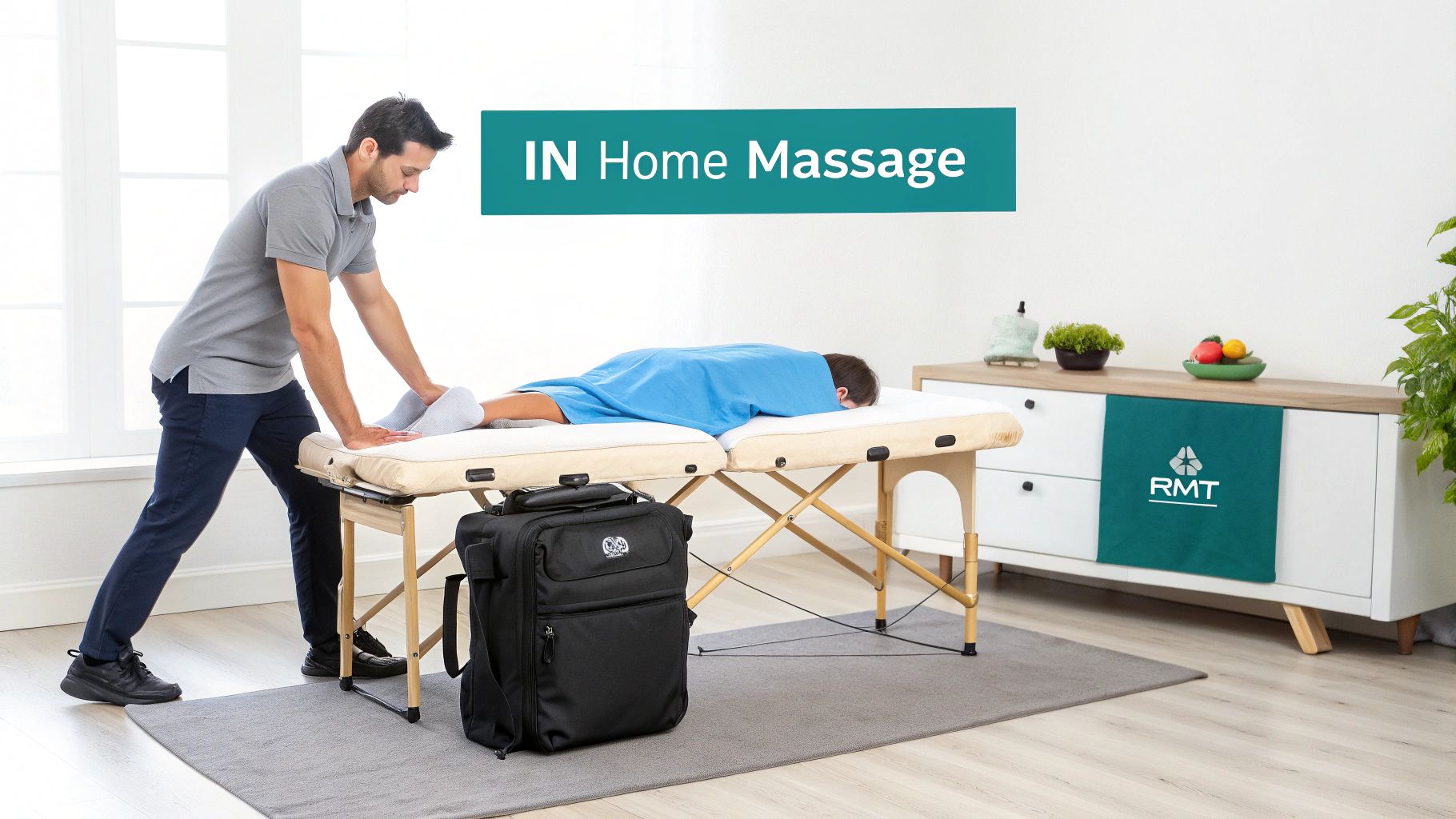
It all starts with a simple booking. Once your time is confirmed, your RMT, Taylor, shows up at your door with everything you'd find in a professional clinic. He brings a sturdy, comfortable massage table, fresh linens, and any special tools needed for your specific sciatica treatment. You don’t have to do a thing except clear a little space for the table.
Your Comfort and Safety Come First
Before any hands-on work begins, Taylor will sit down with you for a confidential health intake. This is a really important conversation. It's your chance to talk about your sciatica symptoms, where the pain is, and your general health history. This chat ensures the treatment is built just for you, avoiding any potential issues and focusing on what will bring you the most relief.
During the actual massage, you'll be professionally draped the entire time. Only the area being worked on is uncovered. Communication is everything. Taylor will check in with you about the pressure and how you're feeling to make sure the therapy is effective without being uncomfortable.
The biggest advantage of getting a massage at home for sciatica is that you don't have to go anywhere. No fighting traffic, no stressful drive home when you're feeling tender or super relaxed. You can just slide off the table and rest in your own favourite chair.
That ability to relax immediately after a session is priceless. It gives your body and nervous system a chance to absorb all the benefits of the therapy, making the relief last longer and helping you heal. To take that home comfort even further, some people find that investing in something like a lift recliner with heat and massage can provide ongoing therapeutic benefits right in their living room. It's about getting professional care with the ultimate convenience.
Your Sciatica Massage Questions, Answered
If you're dealing with sciatica, you've probably got a lot of questions. That’s completely normal. Let's walk through some of the most common things people ask about using massage to find relief.
How Often Should I Get a Massage for Sciatica?
This really comes down to whether you're in the middle of a bad flare-up or dealing with a nagging, long-term issue.
If you’re experiencing a sudden, intense bout of sciatica, we need to get ahead of it. We usually suggest 1-2 sessions per week for the first couple of weeks. This helps calm everything down—the inflammation, the muscle spasms—and gives your body a chance to start healing. Once the worst is over, we can start spacing the appointments out.
For chronic, on-and-off sciatica, it's more about maintenance. Think of it like a tune-up for your body. A regular massage every 2-4 weeks is often enough to keep the muscles from getting tight again, manage your symptoms, and catch potential flare-ups before they even start. After our first session, Taylor will have a much better sense of your body’s needs and can recommend a schedule that makes sense for you.
Will a Deep Tissue Massage for Sciatica Hurt?
We get asked this all the time. The short answer is, it shouldn't feel like bad pain.
When we're working on those deep, stubborn knots that are putting pressure on the nerve, you'll definitely feel it. Many people call it a "good hurt"—an intense, releasing sensation. But here’s the most important part: we are in constant communication. Taylor always works within your tolerance and will adjust the pressure immediately based on what you're feeling. Our goal is to release tension, not to make you grit your teeth.
Can Massage Actually Make Sciatica Worse?
When you're in the hands of a qualified and licensed Registered Massage Therapist, the risk of making sciatica worse is incredibly low.
A trained RMT has a deep understanding of human anatomy and knows exactly what not to do when a nerve is compressed. Taylor knows which muscles to target, which techniques to use, and, critically, how to avoid putting direct, irritating pressure on the sciatic nerve itself. This is precisely why seeing a licensed professional is so important for your safety and for getting real results.
Is Massage Safe for Seniors with Sciatica?
Yes, absolutely. Massage therapy is a wonderful and safe option for seniors, especially when we can bring the treatment right to their home in places like Brampton, Mississauga, or Etobicoke.
We always adapt our techniques to be more gentle, but still very effective. Taylor is trained to consider things like skin integrity, medications (like blood thinners), and any other health conditions. Every single session is customized to ensure it's not only therapeutic but also completely safe and comfortable.
Ready to feel the difference that expert, in-home care can make? At Stillwaters Healing & Massage, we bring compassionate, professional massage therapy right to your doorstep. Let's get you on the path to relief.


