


Physio vs Massage Which Therapy Is Right for You in Ontario
Figuring out whether you need a physiotherapist or a massage therapist can feel a bit murky, but the core difference is actually quite simple. Physiotherapy is a regulated health profession that diagnoses injuries and works to restore proper movement and function, often using evidence-based exercises and other specialized techniques.
On the other hand, Registered Massage Therapy (RMT) is all about the hands-on manipulation of the body's soft tissues—your muscles, tendons, and ligaments. The goal here is usually to ease pain, melt away stress, and get your circulation moving better.
Understanding The Core Differences
While both physio and massage can be fantastic for managing pain, their underlying philosophies, how they assess you, and what they're legally allowed to do are worlds apart. Getting a handle on these distinctions is the first step to making the right choice for your health, whether you're looking for care in Brampton, Toronto, or Caledon.
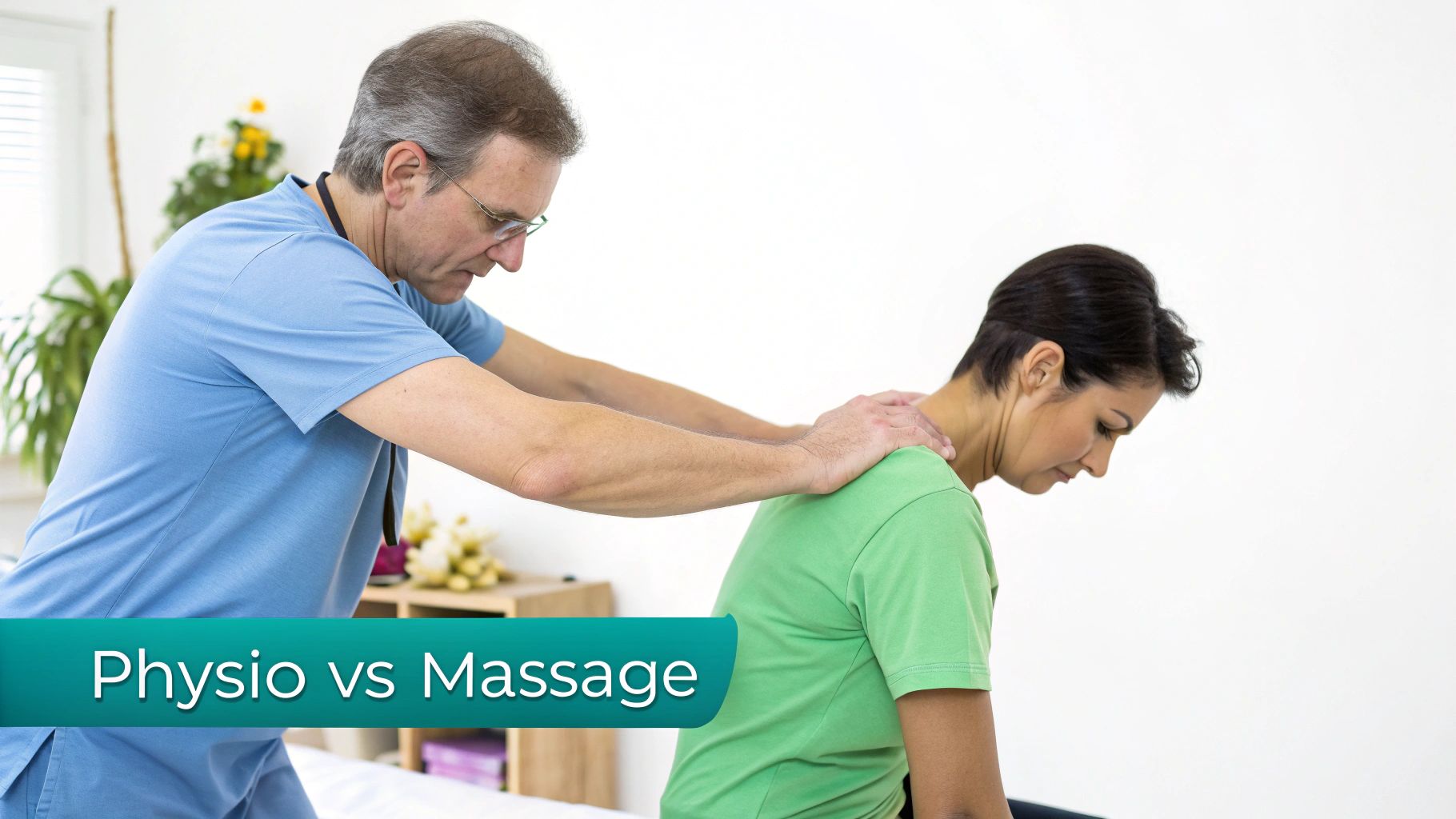
Physiotherapy is really about diagnosis and rehabilitation. A physiotherapist will assess your condition to pinpoint the root cause of the problem. From there, they build a treatment plan that almost always includes specific exercises, education about your body, and other modalities to get you back to functioning well for the long haul. At its heart, physiotherapy is about how your body moves.
Registered Massage Therapy zeroes in on the health of your soft tissues. An RMT uses a wide range of skilled, hands-on techniques to work through muscle tension, calm pain signals, and encourage relaxation. If you're curious about the rigorous training and role these practitioners play in Ontario, you can learn more in our detailed guide on what an RMT is and how they support your well-being.
Physiotherapy vs Massage Therapy at a Glance
To make the physio vs. massage choice a bit easier, it helps to see their primary roles side-by-side. This table offers a quick summary of their essential characteristics so you can see where each therapy truly shines.
Characteristic | Physiotherapy (Physio) | Registered Massage Therapy (RMT) |
|---|---|---|
Primary Goal | Restore function, mobility, and strength after an injury or illness; focused on rehabilitation. | Relieve muscle tension, reduce pain, manage stress, and improve circulation; focused on soft tissue health. |
Approach | Diagnostic; involves assessment, education, prescribed exercises, and manual therapy. | Hands-on; involves direct manipulation of muscles, tendons, and ligaments using various techniques. |
Scope of Practice | Broad medical scope; can diagnose conditions and create comprehensive rehabilitation programs. | Focused on the assessment and treatment of the body's soft tissues and joints. |
Common Use Cases | Post-surgery recovery, stroke rehabilitation, acute sports injuries, and functional movement issues. | Chronic pain, postural strain, stress-related tension, headaches, and general wellness. |
Practitioner Focus | The physiotherapist acts as a rehabilitative coach, guiding you through recovery. | The RMT is a hands-on specialist targeting muscular and fascial issues. |
Ultimately, you can think of it this way: a physiotherapist helps you regain the ability to do an activity, while an RMT helps with the muscle soreness that might come from doing it. Grasping this fundamental difference is crucial as we dive deeper into the specifics of their training, typical assessments, and the conditions each therapy is best suited to treat.
Comparing Professional Training and Scope of Practice
The quality of any therapy really comes down to the practitioner's expertise. When you're weighing physiotherapy against massage, it’s essential to understand the very different educational paths and professional responsibilities each provider has. These differences directly impact the kind of care you'll receive, whether you're recovering from a fall in Mississauga or trying to manage chronic arthritis pain in Oakville.

The journey to becoming a physiotherapist is a long one, steeped in academic and clinical training that prepares them for a diagnostic role within our healthcare system.
The Physiotherapist Pathway
To become a physiotherapist in Ontario, a person first needs an undergraduate degree just to apply for a Master's degree program in physical therapy. This advanced, university-level education is all about the science of movement—anatomy, physiology, biomechanics, and learning treatment protocols backed by solid evidence.
After earning their Master's, graduates have to pass a tough national competency exam. They must then register with a provincial regulatory body, like the College of Physiotherapists of Ontario. This whole rigorous process gives them the legal authority to diagnose conditions, which is a crucial difference from massage therapy. Their scope of practice empowers them to design complete rehabilitation programs, often including prescribed exercises and using specialized equipment.
The Registered Massage Therapist Pathway
A Registered Massage Therapist (RMT), on the other hand, completes an intensive diploma program that usually packs in over 2,200 hours of highly focused training. Their education is laser-focused on anatomy, physiology, pathology, and mastering a huge range of hands-on techniques. Their true expertise lies in assessing and manipulating the body's soft tissues—muscles, tendons, ligaments, and fascia.
If you want to dive deeper into what makes an RMT, you can check out our guide to becoming a Registered Massage Therapist.
Once they graduate, aspiring RMTs also face comprehensive provincial board exams and must register with the College of Massage Therapists of Ontario (CMTO). This ensures they meet strict standards for practice and ethics. While RMTs are skilled at assessing muscles and joints, their scope doesn't include providing a formal medical diagnosis. What they excel at is pinpointing and treating the things that cause pain and discomfort, like muscular imbalances, stubborn trigger points, and fascial restrictions.
How They Fit into Canada's Healthcare Landscape
These different training paths lead to very distinct roles within the Canadian healthcare system. Both professions are in high demand, but they occupy different spaces in the market.
Physiotherapists hold a significant but smaller slice of the overall rehabilitation market. A report from the Canadian Physiotherapy Association noted that physiotherapists make up over 16% of the market, whereas massage therapists are actually the largest group of hands-on therapy providers. This really shows how much people from Toronto to Guelph rely on RMTs to manage their muscular health.
The distinction matters. When you see a physiotherapist, you're getting a diagnostic expert who can guide your functional rehabilitation. When you see an RMT, you’re connecting with a specialist in soft tissue health, skilled in techniques like Swedish massage, cupping therapy, myofascial release, deep tissue massage, and trigger point therapy to get right to the source of muscular pain and tension.
What to Expect During Your First Session
Walking into a clinic for the first time can be a bit nerve-wracking. Knowing what happens behind the closed door for either a physiotherapy or a massage appointment can help you feel prepared and confident you've made the right choice.
While both sessions start with a chat, the similarities pretty much end there. One is a detailed investigation to get to the root of a functional problem, while the other is a hands-on treatment focused on your immediate comfort and muscle health.
To help you feel even more prepared, especially for a massage, take a look at our 5 tips to get the best out of your massage before your appointment.
The Physiotherapy Assessment: A Diagnostic Approach
Your first physiotherapy session is all about investigation. Think of your physiotherapist as a detective trying to solve the mystery of your body's movement and pain. Immediate hands-on treatment isn't always the main event; the first goal is to get a crystal-clear diagnosis.
You'll start with a thorough conversation about your medical history, the nitty-gritty details of your pain or injury, and—most importantly—how it's affecting your day-to-day life. This information is the foundation for everything that follows.
Next comes the physical assessment. Your physiotherapist will likely guide you through a series of specific movements and tests, which could include:
Range of Motion Tests: Checking the flexibility and movement of your joints.
Strength Tests: Evaluating the power in key muscle groups.
Balance and Gait Analysis: Observing how you stand, walk, and carry yourself.
Specialized Tests: Using specific manoeuvres to pinpoint exactly which ligament, tendon, or tissue is the culprit.
This active process leads to a clinical diagnosis. The session usually wraps up with a personalized treatment plan, and you'll almost certainly leave with a set of home exercises. These exercises are your main tool for recovery.
The RMT Consultation: A Hands-On Method
When you see our Registered Massage Therapist, Taylor, the initial session is built around understanding your current state of well-being to provide immediate, targeted relief. The focus is very much on the "here and now" of your muscle tension and discomfort.
The appointment kicks off with a focused chat about what's bothering you—where you feel stiffness, aches, or knots. You’ll also discuss your goals, whether that’s easing chronic pain, simply de-stressing, or recovering from physical activity. This conversation shapes the hands-on treatment you're about to receive.
From there, it’s all about manual therapy. Based on what you discussed, Taylor might use a combination of techniques like:
Swedish Massage
Deep Tissue Massage
Cupping Therapy
Myofascial Release
Trigger Point Release
Joint Mobilization
Hydrotherapy Applications
The entire session unfolds in a calm, quiet environment designed for relaxation and healing. The biggest difference from physiotherapy is this deep emphasis on direct, sustained manual therapy to work on your muscles and other soft tissues.
Interestingly, this intense focus on hands-on work is a defining characteristic of the massage profession, but it also comes at a cost to the practitioner. Research shows that over 60% of Canadian massage therapists report work-related pain, often from the gradual wear and tear of repetitive manual techniques. Physiotherapy, with its blend of exercises and other treatments, tends to put less repetitive strain on the therapist's body. You can read more about these findings on practitioner health if you're curious.
The key distinction lies in the approach: Physiotherapy is a diagnostic process that uses assessment to build a long-term rehabilitation plan. Massage therapy is a therapeutic application of hands-on techniques designed to address immediate soft tissue concerns and improve overall wellness.
Matching Your Condition to the Right Therapy
Trying to decide between physiotherapy and massage therapy isn’t about picking which one is “better.” It’s about figuring out which one is better for you and your specific situation right now. The best choice really boils down to your condition, what you need immediately, and your goals for the future. This section will walk you through some common scenarios to help you match your needs to the most effective therapy.
At its heart, the decision often comes down to a simple question: are you trying to improve function or how you feel? If you need to get moving again, rebuild strength after an injury, or manage a complex neurological condition, physiotherapy is almost always your starting point. But if your main complaint is sore muscles, chronic tension from your posture, or stress-related aches and pains, massage therapy is a fantastic path to relief.
When to Prioritize Physiotherapy
Physiotherapy should be your first call when your goal is all about rehabilitation and getting back your functional independence. It's specifically designed to uncover the root cause of a movement problem and then build a structured, progressive plan to fix it.
Think of physiotherapy as your primary therapy for situations like these:
Post-Surgical Rehabilitation: After a knee replacement, shoulder surgery, or ACL repair, a physiotherapist is your guide. They'll lead you through a safe recovery process to get your strength and range of motion back on track.
Acute Injuries: If you’ve just had a bad ankle sprain, a muscle tear, or whiplash from a car accident, a physio's diagnostic skills are crucial. They ensure you heal properly from the get-go.
Neurological Conditions: For anyone living with a condition like stroke, Parkinson’s, or Multiple Sclerosis, physiotherapy is essential for managing symptoms, improving balance, and staying as mobile as possible.
Loss of Function: Are you suddenly finding it hard to do daily things like climb stairs, get out of a chair, or reach for something on a high shelf? A physiotherapist can figure out what's causing the weakness or pain and help you address it.
The flowchart below gives a nice visual of how each therapy path typically begins.
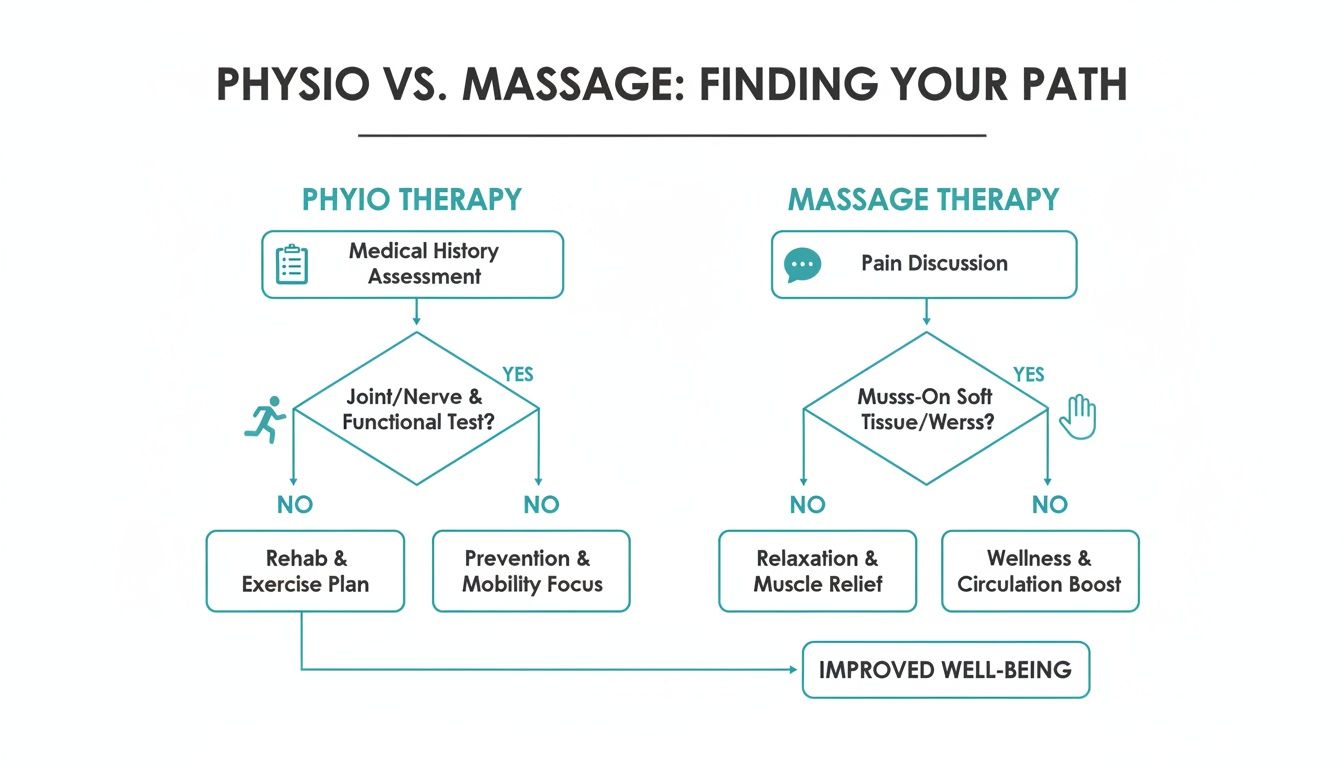
As you can see, physiotherapy kicks off with a diagnostic focus—looking at your medical history and testing your movement. Massage therapy, on the other hand, starts with a conversation about your pain points to guide the hands-on session.
When Massage Therapy Is Your Best Bet
Registered Massage Therapy (RMT) really shines when the problem lies within the body’s soft tissues—your muscles, tendons, ligaments, and fascia. If your pain feels like it's coming from your muscles, a skilled RMT can provide direct, targeted relief.
Massage therapy is incredibly effective for:
Chronic Muscular Pain: This covers everything from that nagging lower back pain you get from sitting all day to persistent neck and shoulder tension. It's also great for conditions like sciatica. If nerve pain is your issue, our guide on how massage helps sciatica offers some deeper insights.
Stress-Related Tension: When life’s stresses show up as tight shoulders, tension headaches, or just a general achiness, massage therapy is a powerful tool. It helps calm the nervous system and release all those knotted-up muscles.
Postural Strain: Spending hours at a desk, behind the wheel, or holding a certain posture creates very predictable patterns of muscle tightness. An RMT is trained to spot and release these specific areas.
Improving Circulation and Flexibility: Techniques used in massage help improve blood flow and lengthen tight tissues, which contributes to your overall sense of wellness and makes movement feel easier.
Don’t forget that for persistent issues like back pain, your environment matters, too. It might be worth finding the best mattress for back pain to make sure your sleeping hours are supporting your recovery, not working against it.
Choosing the Right Therapy for Common Conditions
To make the decision a little easier, here’s a quick-reference table that matches common health goals and conditions with the therapy that’s often the best fit. Think of it as a starting point to guide your conversation with a healthcare provider.
Condition or Goal | Best Choice: Physiotherapy | Best Choice: Massage Therapy | When to Combine Both |
|---|---|---|---|
Post-Surgery Recovery | ✓ Essential for structured rehabilitation, rebuilding strength, and restoring range of motion. | Can help manage post-op muscle stiffness and swelling around the surgical site, but only with surgeon's approval. | Once cleared, massage can ease the muscle tightness that comes from compensating for the healing joint. |
Acute Injury (e.g., sprain, tear) | ✓ The first choice for diagnosis, managing inflammation, and ensuring proper healing from the start. | Not recommended for the initial inflammatory phase. Later, it can address muscle guarding. | After the acute phase, massage can help release muscle tension that developed around the injury. |
Chronic Back/Neck Pain | Addresses underlying causes like weak core muscles, poor posture, and joint dysfunction with targeted exercises. | ✓ Excellent for relieving the direct muscular pain, trigger points, and tightness causing discomfort. | This is a classic combo. Physio strengthens and corrects, while massage provides immediate relief. |
Arthritis Management | ✓ Focuses on improving joint mobility, strengthening supporting muscles, and teaching pain management strategies. | Helps soothe stiff, sore muscles around affected joints, improving comfort and local circulation. | Extremely effective. Physio keeps the joints moving, and massage manages the associated muscle pain. |
Stress & Tension Headaches | Can help by addressing postural issues in the neck and upper back that contribute to headaches. | ✓ Directly targets and releases the tight muscles in the neck, shoulders, and head that trigger headaches. | A great approach. Physio works on long-term posture, while massage provides on-the-spot relief. |
Neurological Conditions | ✓ Critical for improving balance, gait, strength, and overall functional independence. | Can help manage muscle spasticity, reduce stiffness, and improve body awareness and comfort. | Often recommended. Physio works on function, while massage addresses the physical discomfort of the condition. |
General Wellness & Prevention | A physiotherapist can design a preventative exercise program to reduce your risk of future injury. | ✓ A fantastic tool for regular maintenance, stress management, and keeping muscles flexible. | For active individuals, regular massage combined with periodic physio check-ins is a proactive health strategy. |
Ultimately, the best plan is one that's tailored to you. Combining therapies is often the most effective route, especially for long-standing issues, as it addresses both the root cause and the symptoms.
When to Combine Physiotherapy and Massage
You don't always have to choose. In many cases, these two therapies work together beautifully, helping you recover faster and feel better overall. Think of it this way: one restores function while the other manages the muscular discomfort that often comes with rehabilitation.
Combining therapies is a game-changer for chronic conditions. Physiotherapy gives you the "how-to" for moving better, while massage therapy tackles the "why"—the pain and tension holding you back.
This team approach is especially valuable for conditions like arthritis, which affects over 6 million Canadians. Physiotherapy is proven to reduce pain and improve joint function with specific exercises. At the same time, massage therapy is highly effective at cutting pain and stiffness by releasing tight muscles and boosting circulation. The two work on different parts of the same problem.
Consider using both therapies when:
You're in physiotherapy to rehab a joint, but you're dealing with significant muscle soreness and stiffness in the surrounding areas.
You have a chronic condition where strengthening exercises (from your physio) are key, but muscle tightness (which massage can help) is making it hard to do them correctly.
You're an athlete recovering from an injury; physio rebuilds the damaged area, while sports massage helps manage muscle fatigue and prevent new strains from cropping up.
Whether you're in Orangeville, Caledon, or Etobicoke, understanding how these therapies can work in tandem will help you build a much more complete and effective plan for your health.
Navigating Costs and Insurance Coverage in Ontario
Let's talk about the practical side of things: money. Understanding how physiotherapy and massage therapy are paid for in Ontario is crucial, as the costs, insurance rules, and referral needs are quite different. Getting a handle on this from the start helps you plan your care without any financial surprises down the road.
The good news is that most extended health benefit plans in Ontario cover both physiotherapy and services from a Registered Massage Therapist (RMT). The catch? The coverage details are rarely the same.
It’s very common for an insurance plan to set a different spending limit for each therapy. For instance, you might have $750 per year for physiotherapy and a separate pot of $500 per year for massage therapy. Knowing these separate limits is the key to getting the most out of your benefits.
Public vs Private Funding Differences
Here’s one of the biggest financial distinctions between physio and massage: public funding. In Ontario, some physiotherapy services can actually be covered by the Ontario Health Insurance Plan (OHIP).
This OHIP-funded physio is generally for specific circumstances, like:
Following an overnight hospital stay for an issue that needs physiotherapy.
For Ontario residents aged 19 and under or 65 and over.
For those receiving benefits from the Ontario Disability Support Program (ODSP) or Ontario Works.
You typically access these services at designated publicly funded clinics. Massage therapy, on the other hand, is a different story. It's almost always delivered in private clinics and is not covered by OHIP. This means you'll be paying out-of-pocket or using your private health benefits for every session.
The Role of a Doctor's Referral
One of the most common questions we get is about doctor's notes. Do you need one? Legally, no. In Ontario, you can book an appointment directly with a physiotherapist or an RMT in a private clinic without seeing your doctor first.
However—and this is a big one—your insurance company might demand a doctor's referral before they'll pay you back. This isn't a law; it's a rule in your specific insurance policy. Always, always check your benefits booklet or call your provider before your first appointment to see if a referral is needed for either physio or massage.
Forgetting to get a required referral is probably the number one reason claims get rejected. If you want to dive deeper into this, our guide to insurance-covered massage in Ontario is a great resource, full of tips to help you navigate your plan smoothly.
Choosing between physiotherapy and massage isn't just about your physical needs; it’s also about what makes financial sense. By taking a few minutes to check your coverage limits and referral rules for both, you can plan your care with total confidence. Whether you're in Brampton, Toronto, or Halton, a little bit of prep work ensures your focus stays where it should be: on your health.
How to Make Your Final Decision
So, with all this information, how do you actually decide between physiotherapy and massage? It really boils down to one simple question: what’s your primary goal right now?
If you’re trying to diagnose a specific problem, recover from an injury like a torn ligament, or get back on your feet after surgery, a physiotherapist should be your first point of contact. They have the diagnostic skills to figure out the root cause and build a structured rehabilitation plan to restore your body’s function.
When to Start with Massage Therapy
On the other hand, if your main complaint is tight, achy muscles, chronic tension from stress, or those nagging pains that come from sitting at a desk all day, a Registered Massage Therapist is a fantastic choice. Their work focuses directly on releasing that muscular and soft tissue discomfort.
At Stillwaters Healing & Massage, our RMT, Taylor, uses a range of techniques to tackle these issues head-on, including:
Deep tissue massage for those stubborn, deep-seated knots.
Myofascial release to free up restrictive connective tissues.
Rehabilitation massage to support recovery from strain or injury.
Sports massage therapy to help active bodies recover and perform.
Geriatric massage offering gentle but effective relief for seniors.
Energy healing for a holistic approach to wellness.
Why Not Both? A Team Approach to Your Health
It’s crucial to remember this isn’t always an either/or situation. In fact, physiotherapy and massage therapy often complement each other beautifully, leading to better, faster, and more sustainable results.
Think of it this way: physiotherapy is like the structural engineer for your body, rebuilding the framework and ensuring everything works correctly. Massage therapy is the skilled tradesperson who keeps all the supporting materials—your muscles and soft tissues—pliable, healthy, and ready to do their job.
For example, your physiotherapist might prescribe exercises to strengthen your core and support your lower back. At the same time, an RMT can work on releasing the painfully tight back muscles that are making it difficult to even attempt those exercises properly. This kind of collaborative care is often the secret to breaking the cycle of chronic pain for good.
From Brampton and Mississauga to Oakville and Guelph, you have great options for both. Our mobile service makes it even easier by bringing specialized massage therapy right to your doorstep, fitting professional care seamlessly into your life. When you're ready to tackle muscle pain and elevate your well-being, we’re here to help. You can easily book your in-home session with Taylor online to experience expert, targeted care.
Answering Your Questions
When you're trying to figure out whether physiotherapy or massage is the right fit, a few key questions always seem to pop up. Let's clear up some of the most common ones.
Do I Need a Doctor's Referral for Physio or Massage in Ontario?
Legally, no. Here in Ontario, you can book an appointment directly with a physiotherapist or a Registered Massage Therapist (RMT) in a private clinic without getting a referral from your doctor first.
The big "but" here is your insurance plan. Many extended health benefit plans require a doctor's note before they'll reimburse you for the cost. It's a very common requirement, so I always tell people to check your specific plan details before your first appointment. A quick call to your provider can save you a lot of hassle and unexpected expenses.
Could Massage Therapy Make an Injury Worse?
This is a great question and a valid concern. In the hands of a qualified and experienced RMT, massage therapy is incredibly safe. RMTs are trained extensively to understand which conditions are a no-go for massage (contraindications) and how to modify their techniques for your specific health issues. A thorough health history is always the first step to ensure your safety.
That said, for a brand new, acute injury—like a fresh muscle tear, a bad sprain, or significant inflammation—deep tissue massage isn't the right tool for the job and could actually get in the way of the crucial initial healing phase. In those situations, physiotherapy is almost always the better starting point for getting an accurate diagnosis and a safe recovery plan.
Your safety is always the number one priority. A true professional will adjust pressure, work around certain areas, or even tell you to see a physiotherapist first if they feel your acute condition is outside their scope.
How Often Should I Go for a Chronic Condition?
There's really no magic number here; the frequency of your visits will be completely customized to your body, your condition, and your goals.
For a long-standing issue, a physiotherapist might start you off with one or two sessions a week. The goal is to build momentum and establish a solid home exercise program. As you get stronger and more confident managing things on your own, those visits will become less frequent.
For managing chronic muscle pain and stiffness with massage, many people find a consistent schedule of once every two to four weeks works wonders for maintenance. Your therapist will work with you to find a rhythm that feels right and fits your life.
At Stillwaters Healing & Massage, our RMT Taylor specializes in creating customized, in-home massage therapy plans for clients from Etobicoke to Milton and across Halton, focusing on your unique health needs. Experience expert care in your own home by visiting stillwatershealingmassage.clinicsense.com to book your session today.


