


What Is RMT Massage? A Guide to Therapeutic Care
So, what exactly is an RMT massage? When you hear that term, you're not just talking about a simple back rub. You're talking about a specific, regulated form of healthcare delivered by a licensed professional.
A Registered Massage Therapist (RMT) is someone who has gone through thousands of hours of intense education and passed demanding provincial exams. This isn't just about relaxation; it's about assessment-based treatment for your body.
Understanding RMT: A Higher Standard of Care
Here in Ontario, Registered Massage Therapy is a respected and crucial part of our healthcare system. An RMT isn’t just a massage provider; they are a primary healthcare professional. They're trained to assess and treat a whole host of conditions related to your muscles, joints, and nervous system.
Think of it this way: an RMT is a specialist for your body's soft tissues—that’s your muscles, tendons, ligaments, and all the connective tissue holding everything together. Their in-depth training in anatomy, physiology, and pathology allows them to go far beyond just soothing a sore muscle. They get to the root of the problem.
What Sets RMTs Apart?
The biggest difference boils down to regulation and scope of practice. In Ontario, the title "Registered Massage Therapist" is legally protected. This means only individuals who meet the strict standards of the College of Massage Therapists of Ontario (CMTO) can call themselves an RMT.
This isn't just about a title. It's about guaranteeing you receive a consistent, high standard of ethical and professional care. For a deeper dive, feel free to check out our detailed guide to finding a registered massage therapist you can trust.
This professional status brings some major advantages for you as a client:
Targeted Treatment: RMTs don't guess. They create specific treatment plans for issues like chronic back pain, sports injuries, or nagging joint stiffness.
Assessment Skills: Before the massage even starts, they perform a thorough assessment to pinpoint the underlying cause of your discomfort. This ensures the treatment is actually effective.
Insurance Coverage: Because RMT services are a regulated health profession, most extended health benefit plans in places like Brampton, Toronto, and Mississauga will cover a portion of the cost.
This quick table highlights the key differences at a glance.
RMT vs General Massage Provider at a Glance
Attribute | Registered Massage Therapist (RMT) | General Massage Provider |
|---|---|---|
Education | 2,200-3,000+ hours at an accredited college | Varies widely, from a weekend course to a few hundred hours; not standardized. |
Regulation | Governed by a provincial body (like the CMTO in Ontario) with strict standards. | Unregulated in most provinces; no governing body or legal oversight. |
Title Protection | The title "RMT" or "Massage Therapist" is legally protected. | Can use titles like "masseuse" or "bodyworker" but not "RMT." |
Scope of Practice | Can assess and treat musculoskeletal conditions; provides therapeutic, rehabilitative care. | Primarily focused on relaxation and general wellness; cannot legally diagnose or treat specific conditions. |
Insurance | Treatments are eligible for coverage under most extended health plans. | Treatments are typically not covered by insurance. |
As you can see, the RMT designation is a mark of a highly trained and accountable healthcare professional.
The RMT designation signifies that your therapist is held to a high professional standard, required to maintain liability insurance, and committed to ongoing education to stay current with the best healthcare practices.
At Stillwaters Healing & Massage, our RMT, Taylor, brings this exact standard of care right to your doorstep. As a male RMT serving communities from Brampton and Toronto to Caledon and Oakville, he provides personalized, therapeutic treatments designed to meet your unique health goals.
When you choose an RMT, you're not just getting a massage. You're investing in a healthcare partner truly dedicated to your well-being.
The Rigorous Journey to Becoming an RMT
The "RMT" letters after a therapist's name aren't just for show. They represent a demanding journey of education, certification, and ongoing professional development that's legally required to practice in Ontario. This rigorous process is what truly separates a Registered Massage Therapist from a general massage provider, guaranteeing you receive the highest standard of care.
Think of an RMT's education as being on the same level as other regulated health professions. Here in Ontario, anyone wanting to become an RMT must complete an intensive diploma program from an accredited school. We're talking 2,200 to 3,000 hours of in-depth classroom study and hands-on practical training. It's a far cry from a weekend workshop; it's a deep dive into the incredible complexities of the human body.
A Foundation in Health Sciences
The curriculum is designed to create experts who don't just know how the body moves, but why it hurts and how to guide it back to health, safely and effectively.
It's a comprehensive education that covers crucial subjects like:
Anatomy and Physiology: An exhaustive study of the body's structures and functions, from the smallest muscle fibre to entire organ systems.
Pathology: Understanding diseases, injuries, and various conditions to know precisely when massage can help and, just as importantly, when it could be harmful.
Clinical Assessment: Learning how to properly evaluate a client’s condition using specific tests and keen observation to build an effective treatment plan.
Treatment Techniques: Mastering a huge toolbox of hands-on methods to address a wide variety of musculoskeletal and neurological issues.
This is the knowledge base that allows an RMT like Taylor to provide care that is not only therapeutic but fundamentally safe.
The Role of the CMTO
Graduating from a massage therapy program is just the first major step. Before they can call themselves an RMT, a graduate must pass a set of gruelling certification exams. These are administered by the College of Massage Therapists of Ontario (CMTO), the official governing body that regulates the entire profession in our province.
The CMTO's primary job is to protect the public. They do this by setting and enforcing strict standards of practice, a professional code of ethics, and mandatory continuing education requirements that every single RMT must meet to keep their registration active.
This means your RMT is always held accountable for providing competent, ethical, and professional care. It’s your built-in assurance that the therapist you've chosen is qualified, up-to-date, and fully committed to your health. This level of oversight is a huge reason why choosing the right practitioner matters so much. If you want a little more guidance, our post on how to find an RMT in Toronto you can trust is a great place to start.
Ultimately, this whole journey—from thousands of hours of training to passing tough board exams and adhering to the CMTO's high standards—is what makes an RMT. When you book a session with Taylor, you're not just getting a massage; you're getting expert care from a highly trained healthcare professional who is dedicated to helping you feel your best.
The RMT’s Toolbox: A Look at Common Massage Techniques
When you book a session with an RMT like Taylor, you’re getting far more than a simple back rub. It’s a highly specific therapeutic treatment, and every RMT has a versatile toolbox of techniques they can draw from to address exactly what your body needs. There’s no one-size-fits-all script here. Instead, the approach is carefully tailored to your personal health goals.
The path to becoming a skilled practitioner is intensive, ensuring every RMT has mastered a wide range of methods. This journey from student to certified professional is what guarantees they know how to apply the right technique at the right time.
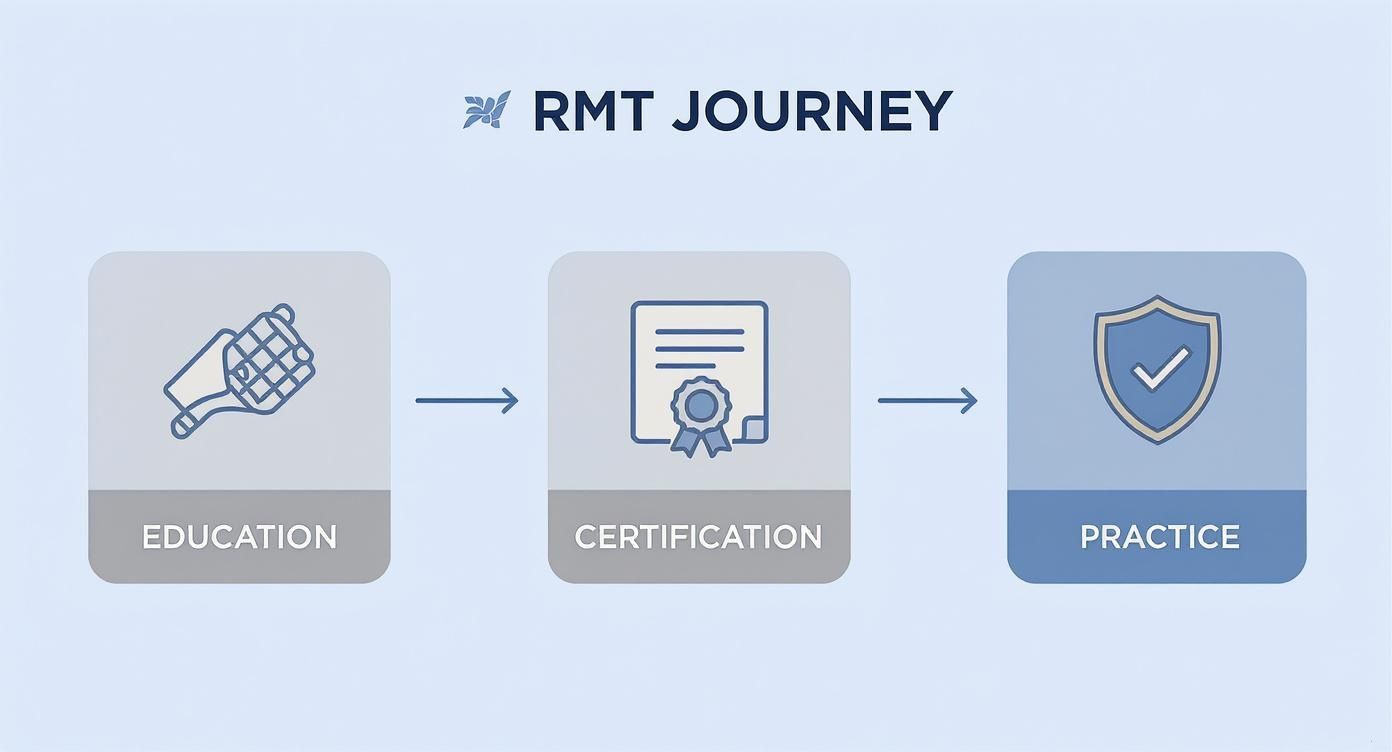
Let's unpack some of the most effective and commonly used techniques Taylor brings to clients from Oakville to Guelph.
Foundational and Advanced Methods
Every technique in an RMT's arsenal serves a distinct purpose, whether it's to boost circulation, release deeply held tension, or improve your range of motion.
Swedish Massage: Think of this as the cornerstone of many massage sessions. It’s characterized by long, flowing strokes, kneading, and gentle circular motions. But don’t mistake it for a simple relaxation treatment; Swedish massage is a powerful way to warm up muscle tissues, improve blood flow, and prepare the body for more focused, deeper work. It’s fantastic for melting away stress and enhancing overall well-being.
Deep Tissue Massage: This technique goes a layer deeper, targeting the underlying muscle and connective tissues where chronic pain often lives. Taylor uses slow, deliberate, and firm pressure to work on issues like a stiff neck, persistent upper back tightness, or sore shoulders. It's especially useful for breaking down old scar tissue and stubborn "knots" (adhesions) that restrict circulation and cause pain.
Getting to the Root of the Problem
Sometimes, the most profound relief comes from zeroing in on the precise source of your discomfort. Two of the most powerful techniques for this are Myofascial Release and Trigger Point Therapy.
Myofascial release works on the fascia—a complex web of connective tissue that surrounds every single muscle and organ in your body. When injury, stress, or overuse causes this tissue to tighten up, it can create pain and restrict movement, sometimes in seemingly unrelated areas. The technique involves applying gentle, sustained pressure to ease these restrictions and bring back fluid motion.
Trigger points, on the other hand, are tiny, hyper-irritable knots within a tight band of muscle. What’s tricky about them is that they often refer pain to other parts of the body. For instance, a trigger point in your shoulder muscle could be the real culprit behind your recurring tension headaches.
Trigger point therapy involves applying direct, focused pressure to these knots to encourage them to release, which can bring about immediate and significant relief. These two methods are often used together to unravel complex pain patterns. If you're curious to learn more, you can dive deeper in our article explaining myofascial release and trigger points.
Matching RMT Techniques to Your Wellness Goals
Not sure which technique is right for you? This table can help you connect your specific needs with the RMT services Taylor provides, whether you're looking for simple stress relief or more intensive injury rehabilitation.
Your Goal | Recommended RMT Technique | What It Does |
|---|---|---|
General Stress & Tension Relief | Swedish Massage | Uses long, flowing strokes to calm the nervous system, improve circulation, and promote relaxation. |
Chronic Aches & Deep Knots | Deep Tissue Massage | Applies slow, firm pressure to target deeper layers of muscle and break down adhesions. |
Widespread Pain & Stiffness | Myofascial Release | Focuses on releasing restrictions in the body's connective tissue (fascia) to restore mobility. |
Specific, Radiating Pain Points | Trigger Point Therapy | Applies direct pressure to deactivate muscular "knots" that refer pain to other areas. |
Sports Performance & Recovery | Sports Massage Therapy | Combines techniques to prepare for athletic events, reduce muscle soreness, and prevent injuries. |
Improved Circulation & Detox | Cupping Therapy | Uses suction cups to lift tissue, increase blood flow, and release toxins and adhesions. |
Pain-Free Joint Movement | Joint Mobilization | Employs gentle, passive movements to improve joint range of motion and reduce stiffness. |
Injury Recovery | Rehabilitation Massage | Focuses on restoring function and reducing pain after an injury or surgery. |
By understanding the "why" behind each approach, it becomes clear that an RMT session is a thoughtful, strategic path to healing. Taylor’s skill lies in his ability to expertly blend these techniques—from broad, foundational strokes to precise, targeted work—to create a truly personalized treatment that supports your health journey.
The Real-World Benefits of RMT Massage
It's one thing to know the theory behind what a Registered Massage Therapist does, but it's another thing entirely to feel the difference in your own body. For folks in Mississauga, Milton, and the surrounding areas, getting treatment from an RMT isn't just a treat—it's a smart, proactive part of staying healthy and mobile. The benefits aren't just vague feelings of "wellness"; they're measurable, backed by evidence, and can genuinely change your day-to-day life for the better.
Think of it less like a simple relaxation massage and more like a targeted strategy to get to the root of what's causing pain or dysfunction in your body.
A Three-Pillar Approach to Wellness
An RMT's work delivers powerful results by focusing on three core pillars of health: managing pain, reducing stress, and helping you recover function. Every session is designed to improve how your body performs and how you feel in it.
Effective Pain Management: For so many people, chronic pain is just a part of life. RMT massage goes right to the source—tackling muscle knots, trigger points, and inflammation that cause the ache. We know from studies that regular massage can seriously reduce low back pain, which is one of the most common complaints out there. If you're dealing with stiff joints, our article on massage for arthritis and joint pain goes into even more detail.
Significant Stress Reduction: The link between a stressed mind and a tense body is crystal clear. RMT massage helps bring down cortisol (your main stress hormone) while giving a nice boost to serotonin and dopamine—the "feel-good" chemicals in your brain. This natural rebalancing can lead to deeper sleep, a brighter mood, and an overall sense of calm.
Accelerated Injury Rehabilitation: After an injury, RMT massage can be a true game-changer in your recovery. By boosting blood flow to the area, breaking down restrictive scar tissue, and helping to reduce swelling, it supports your body’s own healing process. This means you can often regain mobility and get back to your normal activities much faster.
An RMT’s goal is to restore balance. By easing muscle tension and improving circulation, they help create an internal environment where the body can heal itself more effectively and efficiently.
Restoring Mobility and Function
One of the first things people notice after a massage is better flexibility and an easier time moving. When your muscles are tight and the connective tissue around them is restricted, movement can feel stiff, limited, and even painful.
An RMT works to release that tension, allowing your joints to move freely and your muscles to work the way they're supposed to. This improved range of motion can make simple, effective exercises like the Doorway Chest Stretch feel more accessible and beneficial. Restoring that freedom of movement is critical for everyone, not just athletes, but anyone who wants to live an active and independent life.
What to Expect During Your First RMT Session
It’s completely normal to feel a few butterflies before your first RMT massage. Knowing what’s coming can make all the difference, helping you relax and get the most out of your appointment. With Stillwaters, and especially with Taylor, every step of the process is built around your safety, comfort, and active participation in your own health.
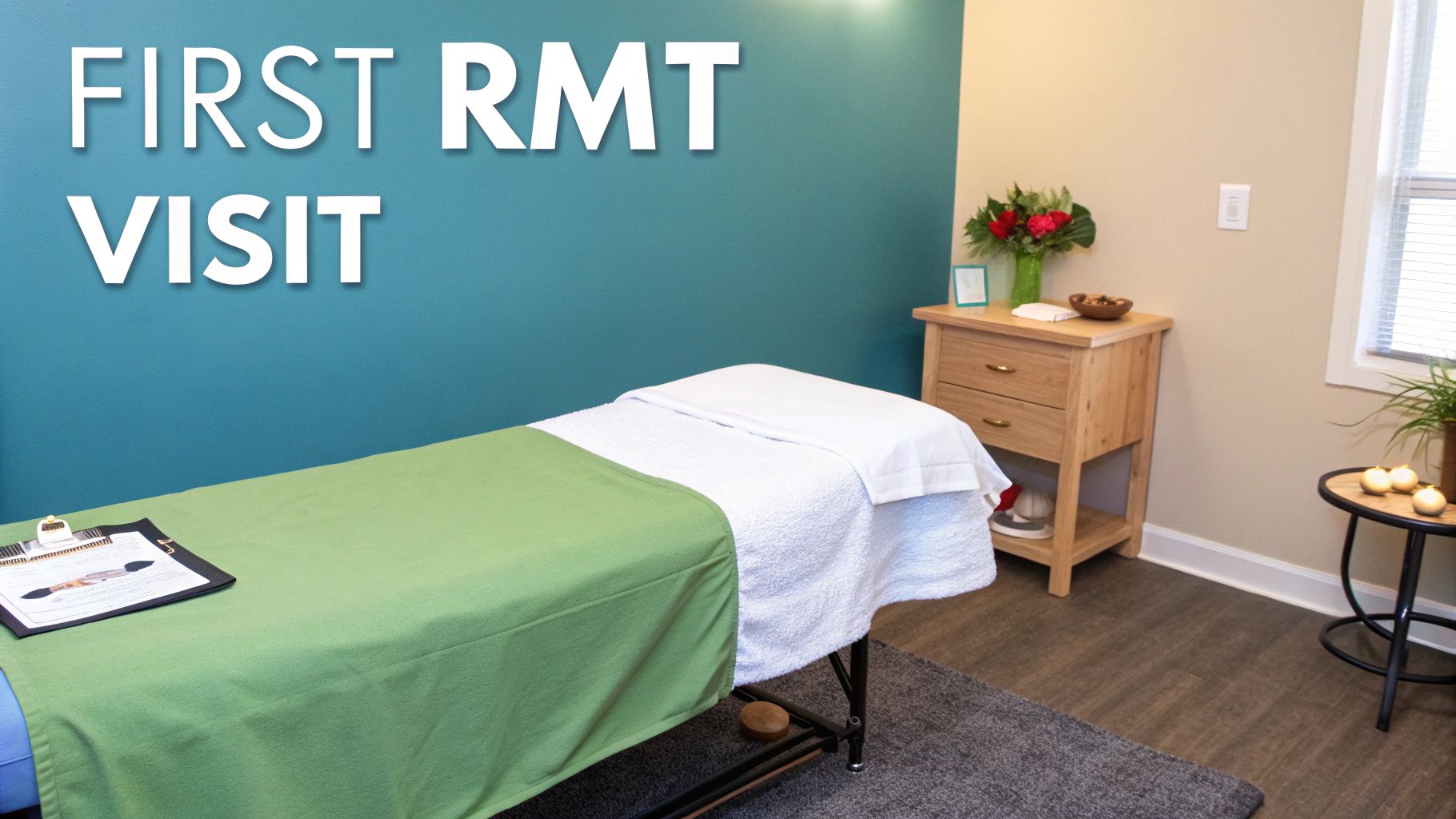
Whether you're in Brampton or anywhere in the Halton region, a good RMT session doesn't just start on the massage table—it starts with a conversation. Your story is the foundation for any effective treatment.
The Initial Conversation and Assessment
Your first appointment kicks off with a confidential chat about your health history. Taylor will want to understand why you’ve come in, what pain or discomfort you’re experiencing, any old injuries that might be relevant, and what you’re hoping to achieve. This isn’t just small talk; it's a critical step that ensures your massage is both safe and tailored to your specific needs.
After the conversation, there might be a brief physical assessment. This could be as simple as checking your range of motion or observing your posture. Think of it as connecting the dots between your story and your body's current state, which helps Taylor create a truly personalized treatment plan just for you.
Consent and Communication
A cornerstone of professional RMT practice is ongoing consent. Before anything begins, Taylor will walk you through the proposed plan—explaining which areas he intends to work on and what techniques he’ll be using. You are always in the driver's seat. You can ask questions, suggest changes, or stop the treatment at any point, for any reason.
Taylor’s entire practice is trauma-informed. This means he is dedicated to creating a non-judgmental space where your comfort and sense of safety are the absolute top priorities. Your boundaries are always the final word.
Communication doesn’t stop once the massage starts. Your feedback is gold. Whether the pressure is too much or too little, or if a certain technique just doesn’t feel right, speaking up is encouraged. This is your session.
The Treatment and Professional Draping
Once you've agreed on a plan, Taylor will step out of the room so you can undress to your personal comfort level and get comfortable on the massage table under a clean sheet and blanket.
During the entire session, you will remain securely covered, a practice known as professional draping. Only the specific area being worked on at that moment—say, your back or one leg—will be uncovered. This standard practice ensures your privacy and warmth are maintained from start to finish.
After the hands-on treatment is over, Taylor will often provide some simple home care advice. This could be suggestions for gentle stretches, using a warm bath for hydrotherapy, or a plan for future sessions. To get even more out of your experience, take a look at these 5 tips to get the best out of your massage. The ultimate goal is to empower you with tools to feel better long after you’ve left the table.
Ready to Start Your Journey to Wellness?
Now that we've unpacked what RMT massage is all about, the next step is feeling the difference for yourself. Think of Registered Massage Therapy less as an indulgence and more as a crucial part of your healthcare routine—a proactive way to manage pain, dial down stress, and simply feel better in your own body. It’s an investment in your well-being that pays off with every comfortable movement and restful night.
For those of you in Brampton, Toronto, Mississauga, and the surrounding communities of Etobicoke, Oakville, Caledon, Orangeville, Milton, Halton, and Guelph, Taylor is dedicated to bringing that high standard of care directly to you.
It's Time to Take the Next Step
Whether you're in Etobicoke dealing with a nagging chronic issue or in Orangeville looking for a way to unwind and reset, professional therapeutic care is closer than you think. Taylor brings his client-focused approach to communities from Oakville to Guelph, helping people get back to feeling their best.
Taking an active role in your health is one of the most empowering things you can do. Booking that first RMT session is a simple, tangible way to put your physical and mental wellness first.
Ready to see what a skilled and caring RMT can do for you? Your path to relief and restoration starts right here.
Book your mobile RMT massage session with Taylor today by visiting our secure online booking portal.
Got Questions About RMT Massage? You're Not Alone.
It's completely normal to have questions before booking any kind of therapeutic care. We want you to feel confident and fully prepared for your session, so we've put together answers to some of the most common things people ask about our services in Brampton, Toronto, and the surrounding areas.
Will My Insurance Cover RMT Massage?
Yes, it most likely will. Registered Massage Therapy is a regulated health profession here in Ontario, which means it’s included in almost all extended health benefit plans.
We always suggest giving your provider a quick call to double-check the specifics of your plan. After every treatment, Taylor provides an official receipt with his RMT registration number, making it simple for you to submit for reimbursement.
What’s the Real Difference Between an RMT and a Spa Massage?
The biggest differences come down to training, regulation, and the overall goal of the session. Think of it this way: an RMT is a licensed healthcare professional who has been trained to assess and treat specific medical issues, whether it's chronic pain, an old injury, or mobility challenges.
A spa massage, on the other hand, is usually all about relaxation. While feeling relaxed is a huge part of what we do, an RMT treatment with Taylor is designed to get to the root of your health concerns for lasting improvement in how you feel and move.
Do I Need to Get Completely Undressed?
Not at all. Your only job is to undress to whatever level feels right for you. Your privacy and feeling of safety are the top priorities, always.
You will be securely and professionally covered with linens for the entire session. Only the specific area being worked on is ever uncovered. Taylor will walk you through everything before you start to make sure you're completely comfortable.
Your comfort is our priority. Open communication ensures the session is a safe, respectful, and healing experience from start to finish. You are always in control of your treatment.
How Often Should I Book a Massage?
That really depends on you and what your health goals are. There's no one-size-fits-all answer.
For acute injuries or specific conditions: We might suggest more frequent sessions at first, maybe once a week, to help manage symptoms and kickstart your recovery.
For general wellness and stress relief: Many clients find that a session every 4-6 weeks is the sweet spot for maintaining balance and keeping tension from building up.
During your first appointment, Taylor will chat with you about your needs and suggest a personalized treatment plan that makes sense for you.
Ready to feel the difference that professional, in-home therapeutic care can make? Stillwaters Healing & Massage brings the clinic to you. Book your appointment with Taylor online today and take the first step toward better health.


