


Myofascial Release Trigger Points Explained
Ever felt a stubborn, tender knot in a muscle that, when you press it, sends a sharp pain to a completely different spot? If so, you've met a myofascial trigger point. These tiny, contracted knots are behind a surprising amount of discomfort, from chronic headaches to that nagging ache in your lower back.
This is where myofascial release comes in—it’s a key therapy designed to find and relieve these troublesome spots.
What Exactly Are Myofascial Trigger Points?
To really get what a trigger point is, you first have to understand fascia. The easiest way to picture it is as a seamless, three-dimensional web of connective tissue that surrounds and weaves through every single part of your body—muscles, bones, nerves, and organs.
Think of it like a finely woven, full-body sweater. When this fascial web is healthy, it's supple and allows everything to glide smoothly, giving you a full, easy range of motion. But life happens. Repetitive movements, poor posture, an old injury, or even just stress can cause this tissue to tighten up, get restricted, and feel "stuck."
How a Trigger Point Forms
It's within these tight, restricted bands of muscle and fascia that tiny, hyper-irritable knots can develop. These are the trigger points. They’re essentially small clusters of muscle fibres that have locked themselves into a contracted state and can't let go.
This constant contraction creates more than just a sore spot; it also restricts blood flow to the immediate area. Without good circulation, the tissue is starved of oxygen and nutrients, and metabolic waste products can't be flushed out effectively. This creates a vicious cycle of irritation and pain.
This condition, known as Myofascial Pain Syndrome (MPS), is incredibly common. In fact, research suggests that 30–85% of people seeking help at pain clinics are dealing with MPS, which is directly caused by these tight muscle knots.
Referred Pain: The Telltale Sign
One of the most distinctive signs of a trigger point is its ability to cause referred pain. This is pain you feel in a location that's different from the actual source of the knot.
It all goes back to that interconnected fascial web. A snag in the "sweater" at your shoulder can easily pull on threads running up your neck, causing a tension headache. In the same way, a knot deep in your glute muscle can send pain shooting down your leg, often mistaken for sciatica.
This is exactly why just rubbing the spot that hurts often doesn't bring lasting relief. The real culprit might be hiding somewhere else, and it takes a knowledgeable approach to locate and release it. If this kind of persistent pain sounds familiar, learning more about a trigger point release massage is a great place to start.
It’s also important to be able to tell the difference between this specific kind of pain and general muscle soreness.
Trigger Point Pain vs General Muscle Soreness
This quick comparison can help you identify if your pain is coming from trigger points.
Characteristic | Trigger Point Pain | General Muscle Soreness |
|---|---|---|
Sensation | Sharp, intense, or a deep ache at a specific point. | A dull, widespread ache across a whole muscle group. |
Location | Feels like a small, hard pea or knot under the skin. | The entire muscle feels tender and tired. |
Pain Pattern | Often refers pain to other predictable areas of the body. | Pain is localized to the muscle that was worked. |
Onset | Can appear suddenly or develop over time from chronic strain. | Typically appears 12-48 hours after strenuous exercise. |
Recognizing these differences is the first step toward getting the right kind of treatment and finally finding relief.
How Myofascial Release Actually Works
So, how can pressing on one tiny, tender spot manage to relieve pain that feels so widespread? It all comes down to breaking a stubborn cycle that’s happening deep inside your muscle tissue. When you understand what’s going on under the skin, you can really appreciate what our male Registered Massage Therapist, Taylor, is doing during your session.
When a trigger point shows up, it’s like a tiny "energy crisis" erupts within a small patch of muscle fibres. These fibres get stuck in a contracted state—they simply can't let go. This constant tightness puts a squeeze on the tiny blood vessels running through the area, choking off the supply of oxygen and essential nutrients.
At the same time, all that metabolic activity creates waste products that can't get flushed out. This is what creates the vicious feedback loop: the lack of energy keeps the muscle fibres locked up, and that contraction stops the fresh energy (blood flow) from getting in. It's why trigger points can stubbornly hang around for months, or even years, without the right kind of help.
Breaking the Pain Cycle
Myofascial release directly interrupts this crisis. When Taylor applies that slow, deliberate, and sustained pressure right on the knot, it’s not about brute force. It's about patient, focused contact.
This careful pressure accomplishes a few critical things all at once:
Mechanical Lengthening: The steady pressure physically coaxes the knotted-up muscle fibres and the surrounding fascia to lengthen and release their grip. Imagine patiently working out a stubborn knot in a shoelace with steady tension instead of just yanking on it.
Restoring Blood Flow: As the knot finally begins to soften, the pressure on those tiny capillaries eases up. This is the moment fresh, oxygen-rich blood can rush back into the tissue, bringing the fuel needed for the muscle to finally relax and start the healing process.
Calming the Nervous System: That therapeutic pressure also sends a powerful message to your central nervous system. It essentially tells your brain it's safe to stop "guarding" the area, which helps turn down the volume on the pain signals that have been firing nonstop.
The Science of the Release
The modern way of looking at this is often called the Integrated Trigger Point Hypothesis. This theory suggests that the "energy crisis" starts with a flood of chemical signals right where your nerves talk to your muscles. This overstimulation is what triggers the initial muscle contraction and kicks off that whole painful cycle. You can dig deeper into the evolving science behind myofascial trigger points and their mechanisms.
By applying precise, sustained pressure, myofascial release effectively hits the reset button on this chemical and metabolic loop. It’s a highly targeted approach that gets right to the physiological root of the knot, which is why the relief it provides is so effective and tends to last.
This work is far more specific than a general massage. While something like a deep tissue massage can be beneficial for overall muscle tension, myofascial release zooms in on the exact source of your referred pain.
Taylor's expertise, honed from working with clients from Mississauga to Caledon, is in finding these very specific points and applying just the right amount of pressure to encourage a release without causing more irritation. It's this precision that makes the technique such a powerful tool for managing chronic pain and getting you moving comfortably again. The goal is always to work with your body to fix the problem, not just mask the symptoms.
Common Trigger Points and Their Hidden Symptoms
One of the trickiest things about muscle pain is that the spot that hurts isn't always the root of the problem. That nagging tension headache you feel behind your eyes? It might actually be starting from a tiny, irritable knot in your shoulder muscle. This is called referred pain, and it’s a classic sign of myofascial release trigger points. Figuring out these connections is the key to finding lasting relief.
Trigger points are masters of disguise. They create symptoms in areas that seem completely unrelated because a tight spot in one muscle can tug on the entire web of surrounding fascia, sending pain signals along very specific pathways. When you learn to read these maps, you can start to decode what your body is telling you and pinpoint the real source of your chronic discomfort.
This infographic shows exactly how myofascial release works to relieve the pain from a trigger point.

As you can see, applying direct, sustained pressure to the knot breaks the pain cycle. This simple action restores healthy blood flow to the starved tissue, which finally allows the contracted muscle fibres to relax and let go.
The Usual Suspects: Upper Back and Neck
If you spend a good chunk of your day sitting—whether at a desk in Oakville or in your favourite armchair—your upper back and neck are prime real estate for trigger points. Two muscles, in particular, are responsible for a surprising amount of "hidden" pain.
The Trapezius: This big, diamond-shaped muscle covers your upper back, shoulders, and neck. When trigger points form here, they’re notorious for causing tension headaches that feel like a tight band wrapping around your head, often settling right behind one eye. You might also feel a deep, burning ache right between your shoulder blades.
The Levator Scapulae: This muscle runs from the top corner of your shoulder blade up to the side of your neck. It’s easily aggravated by things like cradling a phone to your ear or sleeping with your neck at an odd angle. A knot here typically sends a sharp, nagging ache to the base of the neck, right where it meets the shoulder.
So many of these issues are made worse by our daily postures. If you’re dealing with stubborn discomfort from sitting too much, you can find some great starting points in our guide on three tips to relieve back and shoulder pain. Sometimes, small adjustments can make a world of difference.
Pain Imposters: Lower Back and Hips
Pain in the lower back and legs can be complicated, but trigger points are a huge—and often overlooked—piece of the puzzle. They can perfectly mimic symptoms of more serious conditions, which leads to a lot of frustration when treatments aimed at the painful area just don't work.
A perfect example is a trigger point in the gluteus medius muscle, which sits on the side of your hip. A knot here can send a deep, aching pain across the low back and down the side of the leg, feeling almost identical to sciatica or hip bursitis.
Another major player is the Quadratus Lumborum (QL). This is a deep muscle in your low back that connects your lowest rib to the top of your pelvis. Knots in the QL can cause a severe, deep ache in the low back that makes it hard to stand up straight after being seated. The pain can even refer to the hip and groin, adding another layer of confusion.
Learning these common patterns is incredibly empowering. Instead of just chasing symptoms, we can start looking for the actual cause. This understanding helps our RMT, Taylor, conduct a much more effective assessment, tracing your pain back to its origin for a treatment that is both precise and effective.
Common Trigger Points and Referred Pain Patterns
Here's a quick reference table that connects some common trigger points to the symptoms they often produce. It can be surprising to see how far the pain can travel from its source.
Trigger Point Location (Muscle) | Common Sensation | Area of Referred Pain |
|---|---|---|
Upper Trapezius | Tension, tightness | Temple, back of the eye, side of the neck |
Gluteus Medius | Deep ache, soreness | Lower back, buttock, side or back of the thigh |
Quadratus Lumborum | Intense, deep ache | Lower back, hip, groin, buttock |
Infraspinatus (Shoulder Blade) | Burning, deep ache | Front of the shoulder, down the arm, into the hand |
Working with a therapist who understands these intricate connections is the first step toward breaking the cycle of chronic pain. By addressing the true source of your discomfort, you can finally find real, lasting relief.
Your First Myofascial Release Session
Walking into a new therapy session for the first time can feel a little uncertain, but we want to make sure you feel comfortable and confident from the get-go. Knowing what to expect during a professional treatment for myofascial release trigger points can take away any nervousness and help you get the most out of our time together. As a male Registered Massage Therapist, Taylor follows a clear, communicative process to deliver care that’s not just effective, but also right for you.
The entire session is a partnership. From the moment he arrives at your home in Brampton or nearby areas like Mississauga and Etobicoke, his focus is on creating a safe, therapeutic space where we can work together.
The Initial Assessment
We won't jump right into the massage. The first, and most important, step is a conversation and a careful assessment. This really sets the stage for a successful treatment. We'll start by chatting about your symptoms, where you feel the pain, and your overall health history.
Then, Taylor will use expert palpation—a gentle, hands-on method—to feel the muscles and find those specific, tight bands of tissue and the trigger points hiding within them. This isn't just guesswork; it's a detailed physical investigation to map out exactly where your discomfort is coming from. Pinpointing the right knot is the key to unlocking relief.
The Technique: Sustained and Sensitive Pressure
Once we've identified the target trigger points, the hands-on work begins. This is quite different from the broad, gliding strokes you might associate with a Swedish massage. Myofascial release involves applying slow, sustained pressure directly onto the trigger point itself.
Think of a stubborn knot in a thick rope. Simply rubbing over the surface won't untie it. You have to apply patient, steady pressure to encourage the fibres to loosen up and let go. That’s exactly what Taylor does. He’ll use his fingers, knuckles, or elbow to sink into the tissue, holding that pressure for anywhere from 30 seconds to several minutes.
You'll probably feel a very focused intensity right on the spot—a sensation many people describe as a "good hurt." This feeling is the tissue finally starting to release. The idea is to work right at the edge of discomfort without ever pushing into sharp or unbearable pain.
This clinical approach is well-recognized for its results. For example, even medical treatments like trigger point injections are considered a success if they provide at least 50% relief from the primary pain. While our work is non-invasive manual therapy, this shows how targeting these specific points is a clinically validated strategy for managing pain. You can read more about the clinical perspectives on trigger point treatments to understand their effectiveness.
Communication Is Key
Throughout the session, open communication is absolutely essential. The pressure should feel productive, not painful. Taylor will check in with you often, asking for feedback on the intensity on a scale of one to ten.
Your feedback is his guide. It allows him to adjust his technique in real-time, ensuring the pressure is always within a therapeutic range your body can respond to. This constant dialogue makes the session both safe and effective. In fact, feeling empowered to speak up is one of our 5 tips to get the best out of your massage and is crucial for getting the results you want.
Ultimately, the goal of your first session is to start breaking that cycle of pain and tension. By releasing key trigger points, we can restore blood flow, help calm the nervous system, and improve your range of motion. Our aim is for you to finish the session feeling heard, understood, and expertly treated, with a clear path forward toward lasting relief.
At-Home Techniques for Lasting Relief
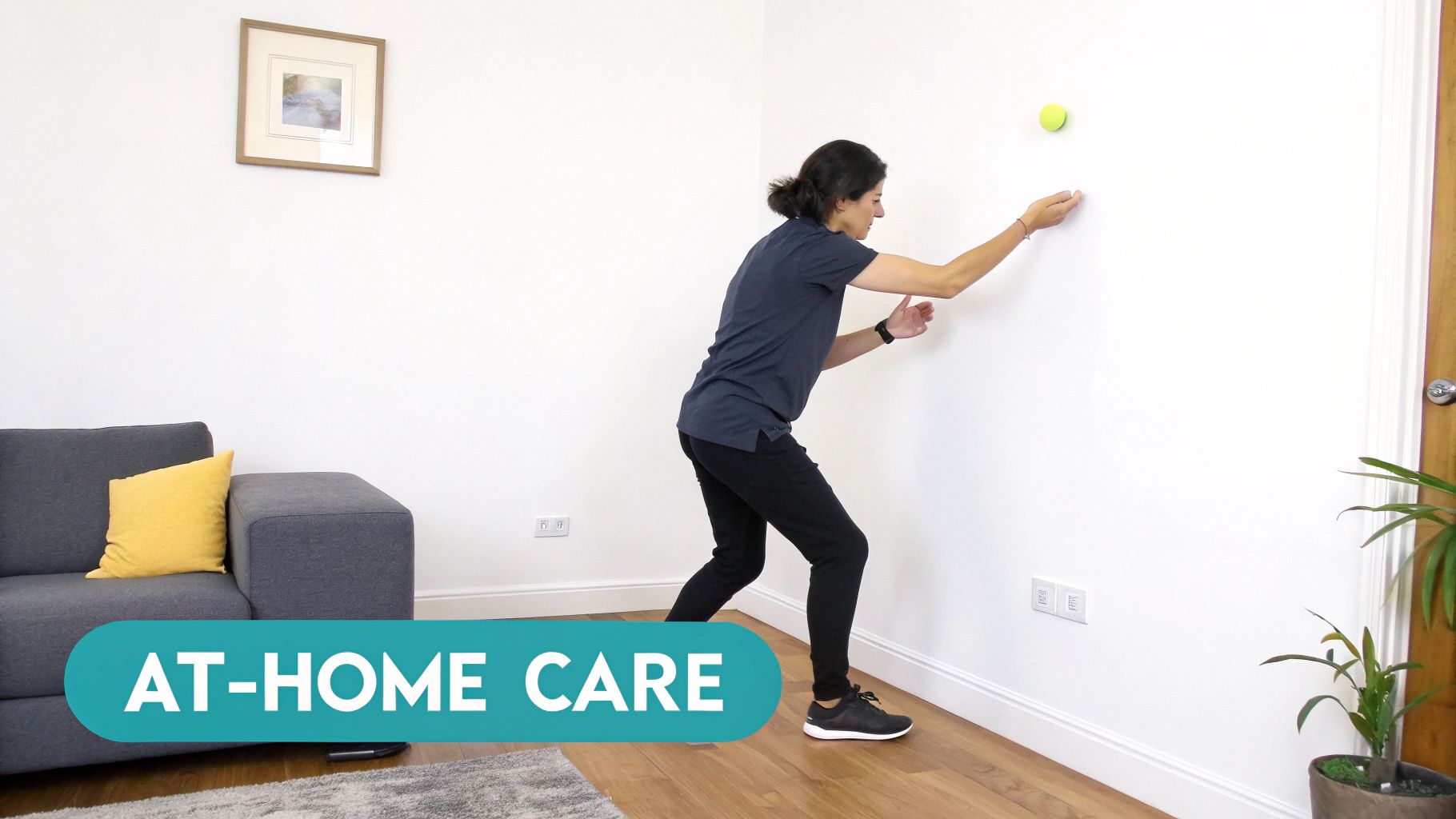
While a professional session with an RMT like Taylor is hands-down the best way to deal with stubborn myofascial release trigger points, what you do between appointments plays a huge role in your long-term comfort. Think of it as homework for your muscles. Learning a few safe, effective techniques empowers you to manage flare-ups and hold onto that feeling of relief for much longer.
It’s about taking an active role in your own wellness journey. And the best part? You don’t need a gym’s worth of equipment to get started. These simple approaches are designed to gently pressure those tight spots, keeping your muscles supple and preventing new knots from setting up shop.
Getting Started with Self-Care Tools
You might be surprised to learn you already have everything you need. Common household items like a tennis ball, or a simple foam roller, can work wonders on those everyday aches and pains.
The real secret is learning to listen to your body. You're aiming for a "hurts so good" sensation—a productive pressure that tells you you're on the right spot, but never a sharp or searing pain. It's a gentle conversation with your muscles, not a fight. For a few more ideas, check out our guide on 3 tools you can use in between massages.
Releasing Shoulder Tension with a Tennis Ball
Shoulder and upper back tension is one of the most common complaints we hear from clients across Brampton and the GTA, especially if you spend a lot of time sitting. A tennis ball is the perfect tool for getting into those tricky spots between your shoulder blades.
Positioning: Stand a few inches from a wall, with your feet about shoulder-width apart. Place the tennis ball between the wall and your upper back, just to the side of your spine and inside your shoulder blade.
Applying Pressure: Gently lean your weight back into the ball until you feel a firm, but comfortable, pressure on a tender spot. You're in control here—bend your knees a little to roll the ball up, down, or sideways to find the perfect spot.
Holding the Release: Once you’ve located a trigger point, just pause. Breathe deeply and try to let the muscle relax into the ball. Hold this pressure for 30 to 60 seconds, or until you feel that knot begin to melt away. Be sure to avoid rolling directly over your spine or the bony ridge of your shoulder blade.
Targeting Glute and Hip Tightness
Did you know that trigger points in your glutes can actually send pain down your leg or into your lower back? It often mimics sciatica. Releasing these deep hip muscles can bring a surprising amount of relief.
Safety First: This is all about gentle, controlled movements. If you ever feel sharp, shooting pain or any numbness, stop immediately. The goal is to ease discomfort, not cause it.
You can do this one while sitting on a sturdy chair or lying on the floor—whatever feels most stable for you.
Find the Spot: Sit down and pop the tennis ball under one of your glute muscles. Slowly shift your weight around until you find one of those tender points.
Sustain the Pressure: Once you’ve found it, just relax into it. Let your body weight do the work. Take a few deep breaths and hold the position for 30-60 seconds before gently rolling off and moving to the other side.
Important Safety Considerations
While self-care is a fantastic tool, it’s vital to know your body's boundaries. Some areas are more delicate than others and should be avoided to prevent injury or irritation.
Areas to Avoid:
The front of your neck and throat
Directly over your spine or any joints (like your knee or elbow)
Anywhere with an open wound, recent injury, or active inflammation
Regions where you have known nerve issues or major blood vessels near the surface
These at-home techniques are meant to complement, not replace, professional care. By weaving these simple routines into your week, you can help your body stay more mobile and comfortable in between your mobile massage sessions with Taylor.
Your Questions About Myofascial Release, Answered
When you're exploring different types of massage therapy, it's natural to have a few questions. This is especially true for a specialized technique like myofascial release. To help our clients, from Brampton to Guelph, feel confident and informed, we've put together some honest answers to the questions we hear most often.
Getting clear on the details is the first step toward feeling comfortable with your treatment.
How Is Myofascial Release Different From a Deep Tissue Massage?
That's a great question. While both get into the deeper layers of your muscle tissue, they work in very different ways. Think of a deep tissue massage as using strong, broad strokes to work out general tightness across a large muscle group. It’s fantastic for that overall feeling of soreness and stiffness.
Myofascial release, on the other hand, is far more specific. It zeroes in on a single, stubborn knot—what we call a myofascial release trigger point—and uses slow, sustained pressure to convince that tight spot to let go. It’s the difference between kneading a whole loaf of dough versus patiently untangling a tiny, tight knot in one string. Taylor, our RMT, often weaves both techniques together for a really comprehensive treatment.
Is Myofascial Release Going to Hurt?
This is probably the most common—and most important—question we get. You’ll definitely feel it. When the pressure is applied to a trigger point, you'll likely experience a very focused, intense sensation. Most clients call it a "good hurt"—it's a discomfort that feels productive, signalling that the tissue is finally starting to release tension it has been holding onto for a long time.
That said, it should never be excruciating or cause sharp, radiating pain. Constant, open communication with your RMT is key. Taylor will check in with you regularly, adjusting the pressure to a level that feels effective but stays within your personal comfort zone. The goal is therapy, not an endurance test. It's also perfectly normal to feel a little sore the next day, similar to how you'd feel after a good workout.
How Many Sessions Will I Need?
There’s no magic number here, as everyone’s body and situation is unique. How many sessions you'll need really depends on your specific condition, how long you’ve been dealing with the discomfort, and what your daily life looks like. For someone with a more recent issue, a single session can sometimes bring remarkable relief.
For chronic problems that have been building up for months or even years, it usually takes a series of treatments to achieve lasting change and help the tissue relearn how to be relaxed. During your first visit, Taylor will do a full assessment and chat with you about a personalized treatment plan that makes sense for your body and your goals.
Our goal is always to get you feeling better in as few sessions as possible. We want to give you relief and the tools to manage it yourself, not create a dependency on treatments. Your progress is what matters most.
Who Is a Good Candidate for Myofascial Release?
So many people can find real relief with this technique. It’s an incredibly effective approach for anyone struggling with chronic muscle pain, stubborn stiffness, or a feeling of restricted movement.
This therapy is especially helpful for:
Desk Workers: If you spend your days at a computer in Toronto or Milton, you’re likely familiar with the trigger points that pop up in the neck, shoulders, and upper back from postural strain.
Athletes & Active People: Releasing fascial restrictions can be a game-changer for improving performance, boosting flexibility, and cutting down on recovery time.
Those with Chronic Conditions: It can provide significant relief for people managing the symptoms of fibromyalgia, persistent tension headaches, and TMJ dysfunction.
Anyone with "Referred Pain": Ever had a headache that you could tell was coming from a knot in your shoulder? Myofascial release is designed to track down and treat that exact kind of problem.
At its core, if you're dealing with musculoskeletal pain that other treatments haven't quite fixed, targeting myofascial release trigger points might just be the key to finally feeling better and getting back to your life.
Ready to get to the root of your muscle pain and stiffness? Stillwaters Healing & Massage delivers professional, compassionate RMT care to your front door in Brampton, Toronto, Etobicoke, Oakville, Caledon, Orangeville, Mississauga, Milton, Halton, and Guelph. Our services include Swedish massage, Cupping therapy, Deep tissue massage, Rehabilitation massage, Myofascial release, Trigger point release, Joint mobilization, Hydrotherapy applications, Geriatric massage, Sports massage therapy, and Energy healing. Book your mobile massage with Taylor today and start your journey to lasting relief.


