


Your Guide to Releasing Muscle Knots in Neck
- tmcpnet
- Jan 15
- 15 min read
That nagging, persistent ache you feel in your neck? It's very real. We're talking about muscle knots, or what professionals call myofascial trigger points. These are those tight, tender spots deep within the muscle tissue that are notorious for causing pain, stiffness, and a frustrating lack of movement. They're one of the main reasons people seek out massage therapy, and getting to know what they are is the first step toward feeling better.
What Are These Painful Lumps in My Neck?

Think of your healthy muscle fibres as a neat bundle of uncooked spaghetti strands—they're smooth, parallel, and glide past each other easily. Now, imagine what happens when you hold a tense posture or overwork a muscle. A few of those strands get stuck together, forming a tangled, contracted clump. That’s essentially a myofascial trigger point.
This tiny, balled-up section of muscle fibres simply can't relax. It ends up cutting off its own blood supply, which starves it of oxygen and nutrients. This irritation creates a vicious cycle of pain and even more tightness, which is why the knot feels like a hard, sensitive lump under your skin. Sometimes the pain stays right there, but often it "refers" pain to other places, like your head, shoulders, or down your arm.
If you're curious about the science behind it all, you can learn more about myofascial release and trigger points in our detailed guide.
To quickly get a handle on what you're dealing with, here's a simple breakdown.
Understanding Neck Muscle Knots at a Glance
Key Aspect | What It Means for You |
|---|---|
What It Feels Like | A hard, tender bump or band in your muscle that hurts when you press on it. |
What It Is | A small, stuck patch of contracted muscle fibres that can't release. |
Why It's a Problem | It restricts blood flow, causes pain, limits your range of motion, and can lead to headaches. |
Putting a name to the pain is the first step. Understanding that it's a physical issue, not just "stress," empowers you to find the right kind of help.
Why Neck Knots Are So Much More Than an Annoyance
For anyone, a knot in the neck is a pain. But for seniors and people with limited mobility, it can be downright debilitating. These knots can lead to chronic stiffness that makes it difficult to simply turn your head to check a blind spot, look up at a shelf, or even get comfortable enough to sleep. It chips away at your daily quality of life.
And this isn't some rare affliction. Neck pain is incredibly common across Canada.
An Ipsos Reid survey revealed that a staggering 35% of Canadians experienced neck pain in the last year, placing it among the most frequent musculoskeletal issues. The study also highlighted that adults aged 55 and over were just as prone to suffering from multiple aches and pains as younger groups, showing these problems don't just go away with time—they often accumulate.
Think of a muscle knot as a micro-cramp. A small cluster of muscle fibres gets stuck in a contracted state and forgets how to let go. This creates a painful, tight band that blocks movement and healthy circulation.
Finding Relief That Comes to You
Knowing what causes the pain is one thing; getting effective, convenient relief is another. For those living in Brampton, Toronto, Etobicoke, Oakville, Caledon, Orangeville, Mississauga, Milton, Halton, and Guelph, professional care is closer than you think.
Stillwaters Healing & Massage eliminates the stress of travel by bringing registered massage therapy right to your doorstep. Our male RMT, Taylor, specializes in working with the unique needs of seniors and individuals managing chronic health conditions. By offering mobile massage therapy, we make it possible to get compassionate, expert care in the safety and comfort of your own home—helping to finally untangle those stubborn knots for good.
The Hidden Causes Behind Your Neck Knots
Those nagging knots in your neck rarely just show up out of the blue. They're usually the end result of our daily habits, physical demands, and even the emotional weight we carry, all of which put a quiet, repetitive strain on our muscle fibres. Getting to the bottom of these root causes is the first real step toward relief because it helps you pinpoint the specific triggers in your own life.
While a lot of things can lead to a tight neck, certain situations pop up again and again for seniors, folks with limited mobility, and the amazing caregivers who support them. It's not a personal failing—it's just how our bodies respond when they're under constant strain.
Everyday Activities and Their Impact
It’s often the little things we do every day, without even thinking, that add up to painful myofascial trigger points. The real troublemaker is any kind of repetition or prolonged strain that makes specific muscles work overtime without giving them a chance to properly rest and recover.
A few common culprits include:
Prolonged Sitting: Spending hours settled into a favourite armchair, a wheelchair, or at a desk can cause the head to creep forward. This posture puts a huge amount of strain on the muscles at the back of the neck as they fight gravity to hold your head up.
Repetitive Motions: Simple, focused activities like knitting, reading with your head tilted down for long periods, or even certain household chores can seriously overwork the same small muscle groups.
Caregiving Duties: Let's be honest, the physical demands of caregiving are immense. The lifting, transferring, and assisting all create significant strain on the neck, shoulders, and back, which is a perfect recipe for chronic muscle knots.
When this kind of tension becomes a regular thing, it creates the ideal environment for muscle knots to form. To help push back against some of these effects, you might find it useful to check out these simple tips to relieve back and shoulder pain, which can make a big difference for your neck too.
How Health Conditions Contribute to Neck Tension
Beyond our daily routines, certain health conditions can create a perfect storm for chronic neck knots. In these situations, the knots aren't the main problem but a secondary symptom—the body’s way of coping with a primary issue.
For example, conditions like arthritis can cause joint stiffness and pain. To avoid that discomfort, you might start holding your neck and shoulders in a tight, guarded posture. This constant tension is a direct line to developing trigger points.
It’s a similar story with neurological conditions like Parkinson's disease or the lingering effects of a stroke, which can change posture and muscle tone. The body often develops new ways to compensate, with some muscles tightening up to make up for weakness in others. The result? Knots and imbalances.
Think of it this way: your body is incredibly smart and will always find a way to get the job done. When one area is weak or painful, other muscles will step up and tighten to provide stability. These muscle knots are just the unfortunate side effect of that brilliant protective instinct.
The Role of Emotional and Mental Stress
The connection between our minds and our muscles is incredibly powerful. When you feel stressed, anxious, or worried, your body’s gut reaction is often to tense up—especially in the neck and shoulders. This is all part of our natural "fight or flight" response kicking in.
But when stress becomes chronic, those muscles might never get the memo to fully relax. They stay in a state of low-grade contraction, which limits blood flow and leads directly to those stubborn muscle knots. Since ongoing stress is such a major factor, it can be really helpful to also discover effective coping strategies for stress to help prevent knots from forming in the first place.
By figuring out if your neck knots are coming from your posture, a health condition, emotional stress, or a mix of everything, you can start tackling the real source of the problem. This insight is key to building a plan that actually works, whether it’s gentle stretches, small changes to your environment, or professional massage therapy from an RMT like Taylor, who serves communities from Etobicoke to Orangeville.
Safe At-Home Stretches for Gentle Neck Relief
When you're dealing with a stubborn knot in your neck, the last thing you might want to do is move it. I get that. But gentle, mindful movement is actually one of the best ways to coax those tense muscle fibres into letting go.
The goal isn't to force a deep stretch. It's about slowly reintroducing motion, improving blood flow, and reminding the muscle how to relax. For seniors or anyone with mobility challenges, all of these can be done safely from a supportive chair.
Before you start, take a second. Sit up tall and imagine a string gently pulling the crown of your head towards the ceiling. This simple act creates a bit of space in your spine and sets you up for success.
Gentle Seated Stretches for Your Neck
Here are three simple but incredibly effective stretches I often recommend. The key is to breathe through them and never, ever push into pain.
Head Tilts (Ear-to-Shoulder): Sit tall and let your right ear drift slowly toward your right shoulder. You're looking for a mild, easy stretch on the left side of your neck. Hold it right there for 15-20 seconds while you breathe. Don't yank your head down or let your other shoulder creep up. Come back to the centre and repeat on the other side.
Chin Tucks: This one feels a bit funny, but it works wonders for tension at the base of your skull. Look straight ahead, then gently draw your chin straight back, like you’re trying to make a double chin. You should feel a nice stretch in the back of your neck. Hold for just 5 seconds, then relax. Aim for 5-10 repetitions.
Gentle Neck Rotations: Keeping your chin level with the floor, smoothly turn your head to look over your right shoulder—only as far as it feels comfortable. Pause for a breath, then bring it back to the middle. Now do the same on the left side. Think smooth and controlled, not fast and forced.
These are meant to feel good and therapeutic. If you feel any sharp pain, tingling, or numbness, please stop immediately.
It’s amazing how everyday habits contribute to these knots. Stress, posture, and strain all play a part in a predictable cycle.
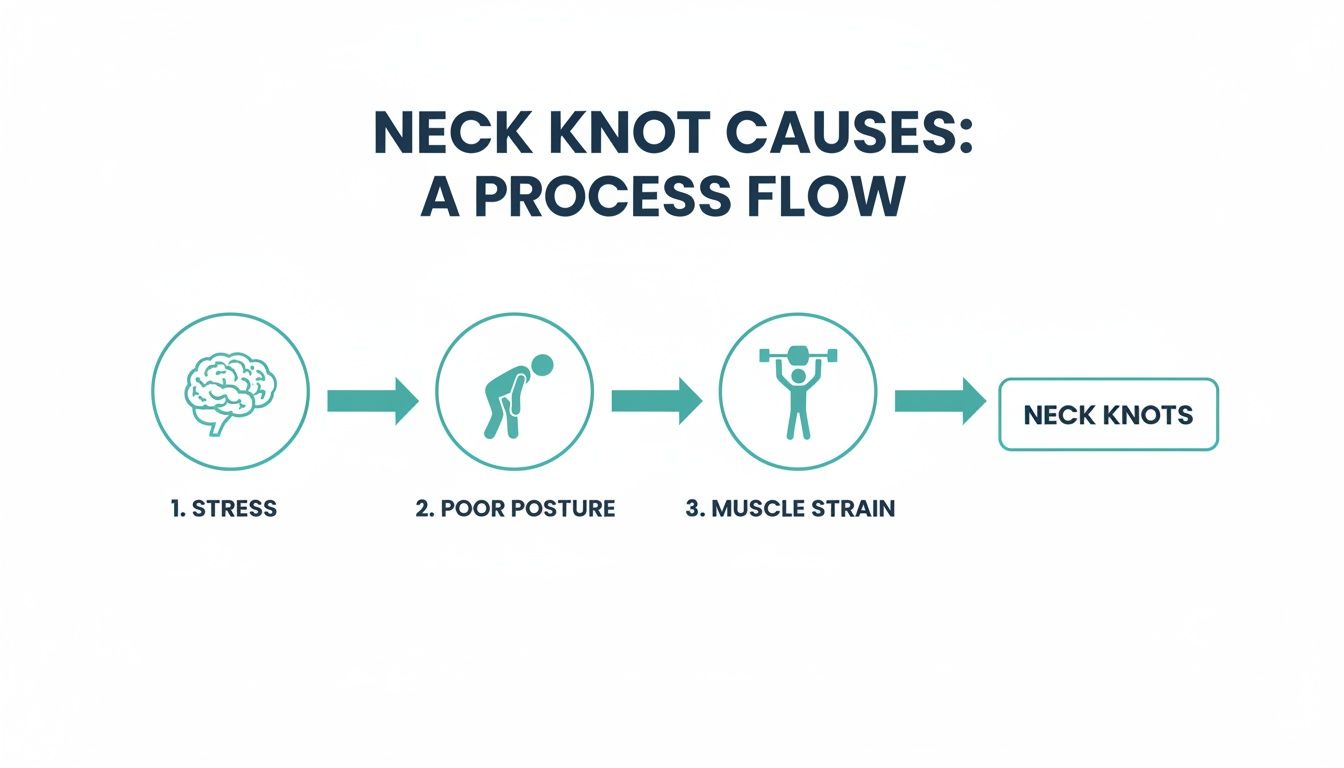
As you can see, what starts as mental stress or a slouched posture quickly becomes physical strain, creating the perfect environment for those painful knots to form.
What to Avoid When Stretching Your Neck
Knowing what not to do is just as important as knowing what to do, especially if you have arthritis or other underlying conditions.
Crucial Safety Tip: Never roll your head in a full circle. This movement can pinch the delicate vertebrae and nerves at the back of your neck. It’s an old-school move that does far more harm than good. Stick to the simple, one-direction movements we just covered.
Also, avoid any quick, jerky, or bouncing motions. Neck stretches should always be slow and deliberate. The mantra here is "less is more." A gentle, sustained stretch will give you much better results than trying to push your body to its absolute limit.
A lovely way to prepare your muscles for stretching is to warm them up first. Relaxing in a warm bath with some Epsom salt bath soaks can make a world of difference.
Consistency Is Your Greatest Ally
Doing these stretches once is nice, but it won't solve a long-term problem. The real magic happens with consistency.
Try to build these movements into your daily routine. Maybe do them first thing in the morning to work out any stiffness from sleep, and again in the afternoon to release the day's built-up tension. This gentle, regular practice helps retrain your muscles to release their grip. For more ideas on what you can do at home, have a look at our post on 3 tools you can use in between massages.
While at-home care is a powerful tool, sometimes you need a professional touch. If the pain just isn't letting up, a registered massage therapist can provide the targeted work needed to release those deep, stubborn knots. For clients from Mississauga to Halton, I bring that expert care right into the comfort of your home, ensuring a safe and effective treatment.
When to See a Professional for That Nagging Neck Pain
Gentle stretches and a bit of self-care can work wonders, but it’s crucial to know when a knot in your neck is more than just a passing ache. Think of it like a persistent noise in your car—sometimes it's nothing, but other times it's a warning sign you shouldn't ignore. Recognizing the difference is key to protecting your health and getting the right kind of help.
What might feel like a simple, tight muscle could actually be your body's way of flagging a deeper issue. Learning to listen to these signals is one of the smartest things you can do for your well-being.
Red Flags: Don't Push Through These Symptoms
If you notice any of the following along with your neck pain, it’s time to pause the self-care and consult a professional like a physician or a Registered Massage Therapist (RMT). These symptoms need an expert eye.
Pain That Travels: Does the pain shoot down your arm? Do you feel any tingling, numbness, or weakness in your hands or fingers? This could point to nerve involvement.
Sudden or Severe Headaches: A headache that feels unusually intense, comes on out of nowhere, or is paired with a stiff neck and fever needs immediate attention.
Dizziness or Loss of Balance: Feeling lightheaded or unsteady on your feet, especially when you turn your head, is a significant red flag.
Pain That Just Won't Quit: If the pain gets worse instead of better despite rest and gentle movement, or if it's strong enough to wake you from sleep, it's time for an assessment.
Ignoring these signs can allow a small problem to become a much bigger one. A skilled RMT like Taylor, who provides in-home care from Mississauga to Oakville, is trained to perform a detailed assessment to get to the root cause of your discomfort.
Why a Professional Assessment Matters So Much
Let's face it, persistent neck pain is incredibly common. The reasons behind it, however, can be surprisingly complex. Research from Ontario Tech University and the Canadian Memorial Chiropractic College revealed just how prevalent neck pain can be. While their study focused on students, it shows a clear pattern of how neck issues can stick around and become chronic problems later in life—something we often see in seniors across the Peel Region and the west GTA due to things like long-term sitting habits or neurological strain. You can read more about these findings on neck pain prevalence.
This is exactly why a professional assessment is so important. An RMT doesn't just poke at the sore spot; they investigate the why behind it.
Reaching out for professional help isn't giving up on self-care. It's the wisest step you can take to get a proper diagnosis and a treatment plan that’s both safe and truly effective for you.
For anyone with a more complex health picture—like arthritis, osteoporosis, or old injuries—a thorough assessment isn't just a good idea, it's essential. Taylor always takes the time to understand your full health history. This ensures that every technique used during your massage is not only helpful but also perfectly safe for your body's unique needs. He can spot the subtle muscular imbalances and compensation patterns that keep those knots coming back, then build a targeted plan for lasting relief.
Booking a session is the first step toward a solution designed just for you. You can easily schedule your in-home massage therapy appointment online.
How Mobile Massage Therapy Unlocks Neck Knots
When those at-home stretches just aren't cutting it for stubborn muscle knots in your neck, sometimes you need a professional, hands-on approach. That’s where mobile massage therapy comes in. It brings specialized care right to your doorstep, targeting the source of your pain in the comfort and safety of your own home. At Stillwaters Healing & Massage, our Registered Massage Therapist, Taylor, uses a combination of proven methods to gently but effectively unlock that constricted tissue and bring your muscles back to health.
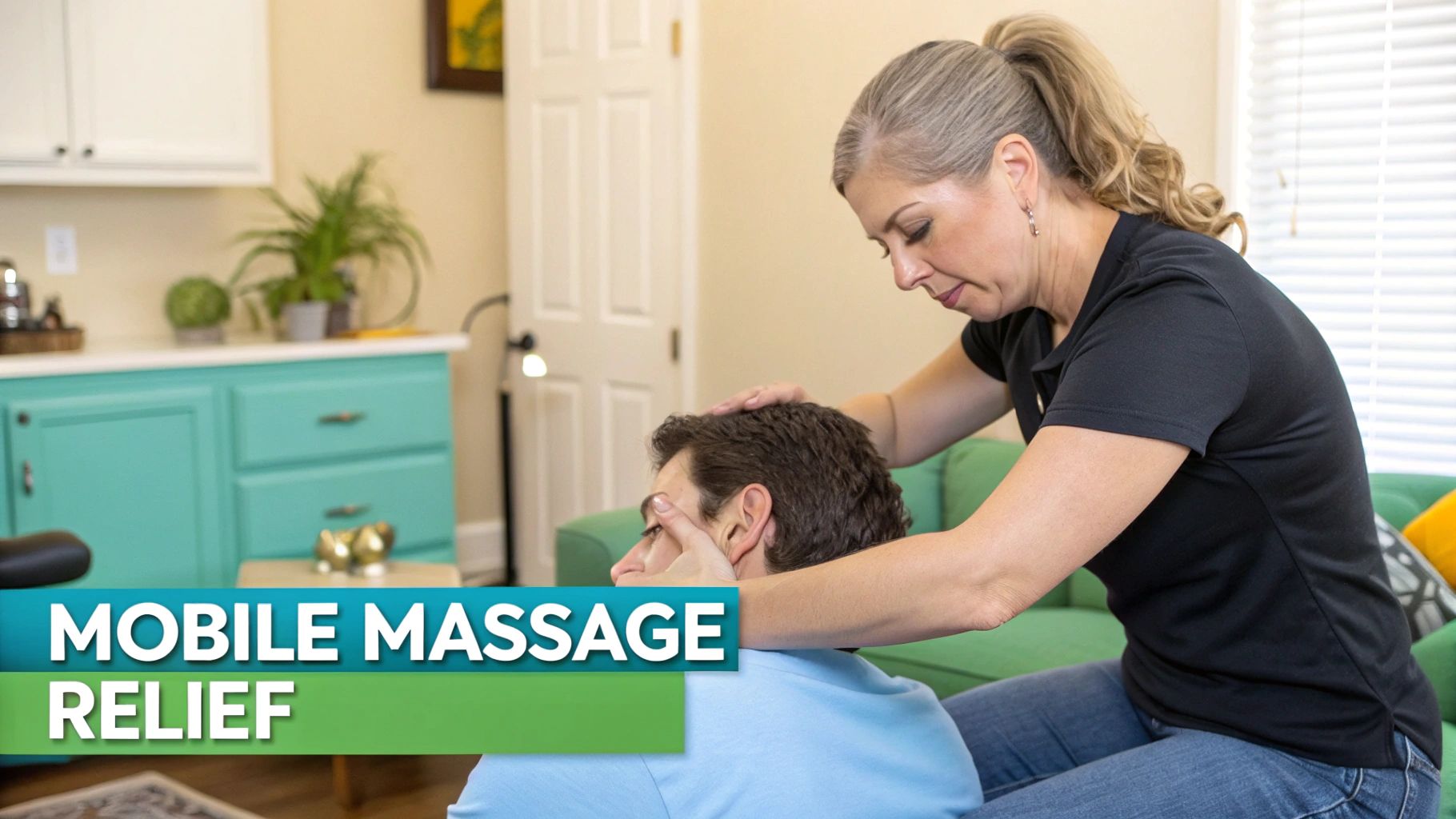
This isn’t a one-size-fits-all solution. Every treatment is thoughtfully designed around your specific situation, especially for our clients with complex health histories or mobility challenges. The goal is always to provide relief, not to cause more pain.
Targeted Techniques for Lasting Relief
To truly get rid of a muscle knot, you have to deal with both the tangled muscle fibres and the tight connective tissue—the fascia—that wraps around them. Taylor specializes in a few key techniques that work together, creating a well-rounded approach to neck pain. Our services include:
Trigger Point Therapy & Myofascial Release: This involves applying slow, sustained pressure directly onto the muscle knot to break up contracted fibres and restore blood flow. We also use gentle, sustained stretching to release the tight connective tissue (fascia) around the muscle, giving it space to relax.
Deep Tissue & Swedish Massage: We use slow, deliberate strokes to reach deeper layers of muscle (Deep Tissue) and promote overall relaxation and circulation (Swedish), releasing chronic tension without causing discomfort.
Cupping Therapy: This practice uses suction to gently lift tissue, increasing circulation and loosening tight muscles from the surface down.
We also offer specialized services like Rehabilitation Massage, Joint Mobilization, Geriatric Massage, and Sports Massage Therapy, ensuring your treatment plan is perfectly tailored to your needs.
Releasing Chronic Tension Gently
The term "deep tissue" can sometimes sound a little intimidating, particularly for seniors or anyone sensitive to pressure. At Stillwaters Healing & Massage, the focus is on therapeutic depth, not painful force.
A gentle Deep Tissue Massage uses slow, deliberate strokes to reach deeper layers of muscle and connective tissue. By working methodically and listening to your body, Taylor can release chronic tension patterns without causing discomfort, making it a safe and effective option for persistent neck knots.
Additional modalities like Hydrotherapy applications can further soothe muscles, while Energy Healing can be integrated to support your overall well-being, addressing both physical and energetic blockages.
Personalized Care for Complex Needs
Managing neck pain can be especially challenging for individuals living with neurological conditions. The body often develops compensatory tension from conditions like Multiple Sclerosis (MS), Parkinson's, or even the after-effects of cancer treatment, leading to severe and chronic muscle knots.
This is where a compassionate and collaborative approach is non-negotiable. Data from Statistics Canada paints a clear picture of the strong link between neurological conditions and chronic pain—a reality for many seniors in the Peel Region. The data shows that among the 1.5 million Canadians with diagnosed neurological conditions, the prevalence of chronic pain is significantly higher. In fact, individuals who have experienced spinal cord trauma face 8.3 times higher odds of chronic pain. You can discover more insights on the connection between neurological conditions and pain.
Knowing this, Taylor works closely with clients, their families, and their caregivers in communities from Caledon to Milton. He takes the time to understand each person's unique health story, ensuring every session is not only effective but also perfectly safe. This means adapting techniques, adjusting positioning, and maintaining open communication throughout the entire treatment. The convenience of this service is a core part of the care, which we detail in our guide to mobile massage therapy in the Greater Toronto Area.
By bringing expert care right to your door in Etobicoke, Halton, and beyond, Stillwaters Healing & Massage removes the barriers to getting the relief you deserve. You can begin your journey toward a more comfortable, pain-free life by scheduling your in-home session today. Simply visit our secure booking page to find a time that works for you.
Booking Your In-Home Neck Relief Session
Living with persistent neck knots can be draining and, frankly, a bit isolating. But as we've walked through, you're far from helpless. We've looked at what these knots really are, gentle ways to find relief on your own, and the clear signs that it's time to bring in a professional. The most important thing to remember is that you are in the driver's seat when it comes to your own comfort.
That next step—getting professional, hands-on care—is where Stillwaters Healing & Massage comes in. Our RMT, Taylor, brings his specialized, trauma-informed approach right to your door. Whether you're in Brampton, Etobicoke, Guelph, or the surrounding areas, the entire experience is designed around your safety, your comfort, and your specific health picture.
Deciding to book a professional massage isn't just about treating pain; it's an investment in your quality of life. You're choosing to tackle the root of the problem and get back to moving freely.
Scheduling Your Appointment Is Easy
We believe getting the care you need should be as seamless and stress-free as the massage itself. That’s why we’ve made booking simple.
Head to Our Secure Booking Page: Just follow the link below to our online scheduler.
Pick Your Service: Choose the type of appointment that makes the most sense for you.
Find Your Ideal Time: Look through the calendar and select an open date and time that fits your schedule.
Fill in Your Details: A few quick pieces of information, and you're all set.
If you'd like a complete walkthrough of what happens from booking to treatment, our ultimate guide to booking a massage at-home service has all the details.
Ready to feel the difference? Let's take that first step toward a more comfortable, mobile you.
Frequently Asked Questions
Thinking about in-home massage for those stubborn muscle knots in your neck can bring up a few questions. We get it. Here are some of the most common things people ask, especially when they're arranging care for themselves or a loved one in places like Mississauga, Brampton, and Oakville.
Is Deep Tissue Massage Painful for Seniors?
It absolutely shouldn't be, and with us, it isn't. When we say "deep," we're talking about the therapeutic effect we're aiming for, not the amount of painful pressure.
Our male RMT, Taylor, is skilled in geriatric care and knows how to work within your comfort zone. He uses slow, deliberate pressure that coaxes knots to release without causing discomfort. Constant communication is key to his approach, so you always feel safe and in control during your session, whether you're in Etobicoke or Milton.
What Should I Expect During a Mobile Massage Appointment?
Think of it as bringing a professional clinic right to your door, without any of the hassle. Taylor arrives with everything needed: a sturdy massage table, fresh linens, and any other tools, like cups, that might be part of your treatment.
All you need to provide is a small, clear area for him to set up. Your first session always starts with a detailed chat about your health history and what you hope to achieve. This helps him build a treatment plan just for you, making the whole experience in Halton or Guelph private, comfortable, and stress-free.
A mobile massage therapy appointment is designed to remove the stress of travel and scheduling. It brings professional, registered care into a familiar environment, making it easier for you to relax and receive the full benefits of the treatment.
How Often Should I Get a Massage for Chronic Neck Knots?
That’s a great question, and the honest answer is: it depends. Everyone’s body and situation are different, so there’s no magic number that works for all.
After your first assessment, Taylor will talk through what he’s found and recommend a starting point. Many of our clients in Toronto and Caledon find that a weekly session at the beginning really helps get the initial pain under control. As you start feeling better, you might move to every other week or even monthly for upkeep. We'll figure out a rhythm that works best for you and your wellness goals.
Ready to experience personalized, professional relief from neck knots in the comfort of your own home? Stillwaters Healing & Massage is here to help.


