


Pain Under Left Shoulder Blade: Causes, Red Flags, and Relief
That nagging ache under your left shoulder blade isn't just a nuisance; it's a signal. Your body is trying to tell you something, and while the cause is often simple muscle strain or poor posture, it's important to know how to listen.
What's Causing That Pain Under My Left Shoulder Blade?

Think of that pain as your upper back's "check engine" light. Sometimes, the problem is right where the light is flashing—a muscle knot from sleeping funny or a strain from lifting a heavy grocery bag.
But other times, that discomfort is referred pain, a sign of trouble somewhere else in the body. That's why figuring out the why is the first real step toward feeling better.
The Usual Suspects: Muscle and Posture Problems
For most of us, the culprit is musculoskeletal, meaning it has to do with our muscles, bones, and the tissues connecting them. This is often the case if you’ve been:
Hunching over a screen: Spending hours at a desk or staring down at your phone puts a ton of stress on the muscles that run between your spine and shoulder blade, like the rhomboids and trapezius. They get tired and start to protest.
Overdoing it: Did you start a new workout, spend the weekend gardening, or lug a heavy purse on one shoulder? Overuse can cause tiny tears in muscle fibres, leading to that familiar pain and inflammation.
Dealing with Trigger Points: These are essentially tight, irritable knots in your muscle tissue. They can feel like a sharp, specific point of pain or send a dull ache radiating across the area. We dive deeper into these pesky knots in our guide to myofascial release and trigger points.
This guide is here to give you knowledge and empower you to take action. It's not a substitute for a professional diagnosis. If your pain is severe, came on suddenly, or you have other worrying symptoms, please see a healthcare professional right away.
To help you get a clearer picture, we've put together a simple table. Think of it as a starting point for figuring out if your symptoms point toward a simple muscle issue or something that needs a doctor's attention.
Quick Guide to Potential Causes of Left Shoulder Blade Pain
Category | Common Examples | When to Seek Medical Advice |
|---|---|---|
Likely Muscular Issues | Dull ache, stiffness, pain that gets worse with movement, feeling of "knots" | If the pain is severe, doesn't get better with a few days of rest, or stops you from doing daily activities. |
Potential Medical Red Flags | Sudden sharp pain, shortness of breath, pressure in your chest, fever | Immediately. These can be signs of serious conditions and shouldn't be ignored. |
Understanding this difference is everything. If it's a muscular problem, a skilled Registered Massage Therapist (RMT) like Taylor from Still Waters Healing Massage can work wonders. Taylor serves clients across a wide area—including Brampton, Toronto, Etobicoke, Oakville, Caledon, Orangeville, Mississauga, Milton, Halton, and Guelph—and specializes in getting to the bottom of your discomfort. He provides targeted, therapeutic massage to bring real relief, all in the comfort of your own home.
Let's Look at the Most Common Musculoskeletal Culprits
While it's wise to be aware of the more serious possibilities, the good news is that most of the time, pain under the left shoulder blade is coming from your muscles, bones, and the tissues connecting them. Your upper back is a complex hub of muscles, all working together to move your arms, neck, and torso. When one part of this intricate system gets overworked or injured, it can cause a cascade of pain and tension.
Often, this discomfort can be traced back to everyday life. Did you spend the weekend gardening? Were you hunched over your laptop to meet a deadline? Even something as simple as sleeping in a funny position can strain the muscles around your scapula (the technical name for your shoulder blade).
When Muscle Strain and Overuse are to Blame
The most common reason for that deep, nagging ache is straightforward muscle strain. The muscles most often involved are the rhomboids (which connect your spine to your shoulder blades) and the trapezius, that large, diamond-shaped muscle covering your upper back and neck.
When you push these muscles too hard with repetitive movements—think scrubbing floors, hours of typing, or always carrying a heavy bag on the same shoulder—you create tiny micro-tears in the muscle fibres. Your body responds with inflammation, which is what causes that familiar stiffness, tenderness, and dull ache under your left shoulder blade.
Think of your rhomboid muscles as a pair of strong elastic bands that hold your shoulder blade steady. If you sit at a desk reaching forward all day, those bands get stretched out and tired. After a while, they'll start to ache in protest.
The Problem with "Knots" or Trigger Points
Beyond a general strain, you might be dealing with trigger points. These are tiny, irritable spots in the fascia (the thin sheath of connective tissue around your muscles). We usually call them "muscle knots," and they feel like small, tender bumps that can be a major source of pain.
A trigger point isn't just a tight muscle; it's a small patch of muscle fibres that are stuck in a contracted state. This doesn't just cause pain right where the knot is—it can also send pain to other areas. For example, a knot in your upper trapezius muscle can make it feel like the pain is coming from directly under your shoulder blade. To dig deeper into this, check out our guide to relieving knots on shoulder blades.
Here's a helpful way to picture it: Imagine a trigger point is like a stubborn tangle in a rope. That one little knot can effectively shorten the whole rope and create tension far away from where the actual tangle is. A skilled RMT knows how to find that specific knot and use targeted pressure to help it release.
When the Pain is Coming from Your Neck
Sometimes, the pain you're feeling under your shoulder blade isn't actually starting there. The real problem might be in your neck, which is a classic example of referred pain. Your body is wired with a complex network of nerves, and when a nerve in your neck (your cervical spine) gets pinched or irritated, it can send pain signals shooting down its pathway into your shoulder area.
This is often caused by things like a herniated disc or age-related wear and tear in the neck. Your brain essentially gets its signals crossed and interprets the pain as coming from your shoulder blade instead of the neck. It’s like a faulty electrical circuit where a problem in the main fuse box makes a light flicker in another room entirely.
These kinds of musculoskeletal issues are incredibly common. Research shows that repetitive strain is a major driver of this type of pain, affecting a huge portion of the adult population. Getting on top of it early is key, as ongoing pain can really interfere with your daily life and ability to work.
A thorough assessment is the only way to figure out what's really going on. A Registered Massage Therapist is trained to pinpoint the exact tissues causing the problem. By using a combination of techniques like Swedish massage, Cupping therapy, Deep tissue massage, Rehabilitation massage, Myofascial release, Trigger point release, Joint mobilization, Hydrotherapy applications, Geriatric massage, Sports massage therapy, or Energy healing, they can get to the true source of your pain and provide relief that actually lasts.
Recognizing When Shoulder Blade Pain Is a Red Flag
Most of the time, that nagging pain under your left shoulder blade is just what it feels like: a muscle strain from sleeping funny or spending too much time hunched over a keyboard. But every so often, it can be your body’s way of sounding an alarm for something more serious.
Think of it like a smoke detector going off in the hallway when the fire is actually in the kitchen. The pain is real, but its source might be somewhere else entirely. Learning to tell the difference between a simple muscle ache and a genuine red flag is key to getting the right help, right when you need it.
This kind of "referred pain" can signal trouble in one of three major areas: your heart, your lungs, or your digestive system. The trick is to look beyond the shoulder pain itself and pay close attention to any other symptoms that have come along for the ride.
Cardiac Warning Signs to Heed
Let's start with the most serious one: your heart. A heart attack (myocardial infarction) doesn't always look like it does in the movies. While chest pain is the classic sign, many people—especially women—experience less obvious symptoms, and a sharp pain in the left shoulder blade can be one of them.
This is a true medical emergency. If your shoulder blade pain comes on suddenly and is paired with any of the following, don't hesitate:
Pressure, squeezing, or a feeling of fullness in your chest that might come and go.
Shortness of breath, even if you haven't been active.
Pain that travels up into your jaw, neck, back, or down your left arm.
Breaking out in a cold sweat, feeling light-headed, or sudden nausea.
These symptoms are your cue to act immediately. Don't try to "wait it out" or brush it off as heartburn. Call 911 right away; every second counts.
When Your Lungs Are in Distress
Your lungs sit right behind your shoulder blades, so it makes sense that a problem there could be felt in your back. Conditions like a pulmonary embolism (a blood clot in the lung) or a collapsed lung (pneumothorax) can cause a sharp, stabbing pain right in that spot.
This kind of pain often gets much worse when you try to take a deep breath or cough. Be on high alert if the shoulder pain shows up with:
Sudden and severe difficulty breathing.
A sharp, piercing chest pain that gets worse with every breath.
A racing heart or a feeling of overwhelming anxiety.
A cough, which might even bring up bloody sputum.
These are urgent signs that something is seriously wrong with your respiratory system. It's time to get an immediate medical assessment.
It's essential to differentiate between musculoskeletal pain that needs therapeutic care and symptoms that signal a deeper medical issue. Understanding which path to take is vital for your health, which is why we explore the roles of different practitioners in our guide comparing physiotherapy vs. massage therapy in Ontario.
Gastrointestinal Emergencies
Believe it or not, trouble in your belly can also send pain signals up to your shoulder. A major nerve, called the phrenic nerve, travels from your abdomen up toward your neck, and if it gets irritated by an internal issue, it can refer pain to your shoulder area. Organs like the pancreas and gallbladder are common culprits.
For instance, pancreatitis (an inflamed pancreas) can trigger a severe, deep pain that radiates from your upper abdomen straight through to your back, landing right under the left shoulder blade. A perforated stomach ulcer is another serious emergency that can cause sudden, intense pain in the same region.
Keep an eye out for these other warning signs:
Severe, unrelenting abdominal pain, especially if it gets worse after you eat.
Nausea, vomiting, and a fever.
An abdomen that feels unusually tender, hard, or rigid to the touch.
If you recognize any of these red flag symptoms alongside your shoulder pain, it’s crucial to seek medical help. For pressing concerns, an online urgent care service can offer a quick consultation, but for anything severe, the emergency room is your safest bet. Your health always comes first, and knowing these warning signs is the most important step you can take.
How Therapeutic Massage Unlocks Lasting Relief
When you've got a stubborn pain nagging you under your left shoulder blade, just rubbing the spot rarely works for long. Why? Because that ache is usually just a symptom. The real culprit is often a deeper issue, like a tough muscle knot or widespread tightness in the surrounding connective tissue.
A skilled Registered Massage Therapist (RMT) approaches this like a detective. He doesn't just treat the sore spot; he investigates the root cause to find a solution that actually lasts.
For those living in Brampton, Mississauga, Milton, and Guelph, this kind of expert care is more accessible than you might think. Taylor, a dedicated male RMT, brings a professional, clinical-level experience right to your home. This is a game-changer for seniors or anyone with mobility challenges who needs consistent, effective care without the hassle of travel.
Going Beyond a Surface-Level Rub
A therapeutic massage is a world away from a typical spa treatment. Think of it as a targeted medical treatment designed to sort out the specific musculoskeletal problem causing your pain. Taylor uses several advanced techniques to get at the deep-seated tension patterns responsible for that ache under your shoulder blade.
Three of the most powerful approaches for this kind of pain include:
Deep Tissue Massage: This isn't about painful pressure; it's about smart pressure. Using slow, firm strokes, the therapist reaches the deeper layers of muscle and fascia. Imagine carefully untangling a series of knotted ropes. The goal is to release those chronic knots and adhesions (bands of painful, rigid tissue) that are restricting your movement.
Trigger Point Therapy: You know those tiny, super-sensitive spots in a muscle that can send a jolt of pain elsewhere? Those are trigger points. A knot in your upper back muscle, for instance, can refer a sharp ache directly under your scapula. This therapy applies focused, steady pressure to these points to deactivate them, which quiets the pain signals and lets the muscle finally relax.
Myofascial Release: Your muscles are all wrapped in a thin, strong web of connective tissue called fascia. When posture, injury, or stress causes this web to tighten up, it can pull on everything, causing serious pain and stiffness. Myofascial release uses gentle, sustained pressure to slowly stretch and loosen this fascial web, restoring mobility and getting rid of that "stuck" feeling.
This decision guide can help you understand when to try therapeutic massage for a dull, aching pain versus when to seek immediate medical help for something more serious.
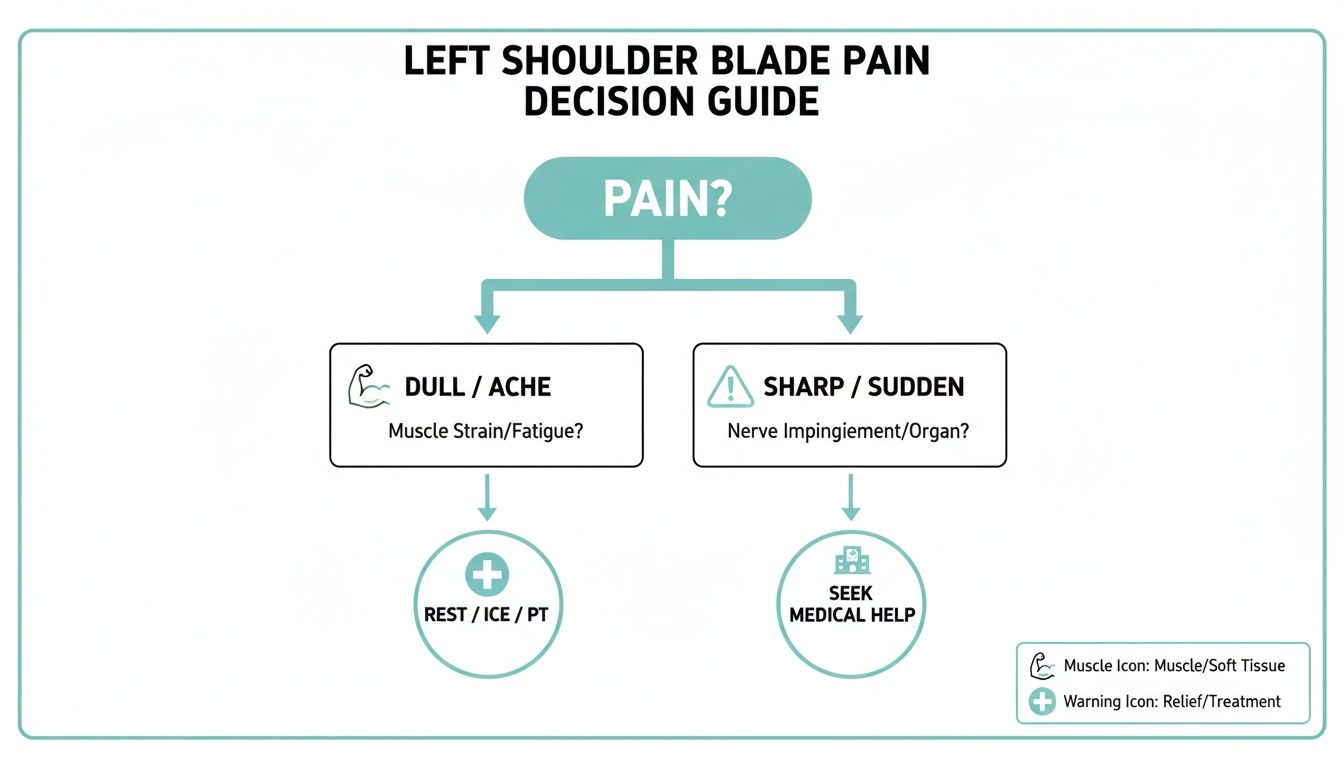
As the chart shows, muscular aches are a perfect match for massage therapy, but sharp pain combined with other symptoms needs a much more urgent response from a doctor.
Your Personalized Path to Feeling Better
Getting rid of your shoulder blade pain for good starts with a thorough, professional process. An experienced RMT like Taylor won’t just start kneading the area; he’ll first build a complete picture of your health to make sure the treatment is both safe and effective for you.
Here’s what you can expect the process to look like:
Initial Assessment: It all begins with a conversation. Taylor will ask about your pain—when it started, what it feels like, and what makes it better or worse. He’ll then do a physical assessment to check your range of motion and figure out exactly which muscles are involved.
Creating a Treatment Plan: Using the information from the assessment, a personalized plan is created just for you. This plan will map out which techniques will work best, whether that's Deep Tissue Massage, Myofascial Release, Cupping Therapy, or a combination of methods. To see how these therapies work together, you can read our in-depth article on unlocking pain relief with therapeutic massage.
Hands-On Treatment: During your session, you are always professionally draped with linens, and only the area being worked on is uncovered. Taylor will check in with you to make sure the pressure is just right—therapeutic but comfortable—and will adjust his approach as he feels the tension begin to release.
Ongoing Care and Education: Lasting relief is about more than what happens on the massage table. Taylor gives you the tools you need to stay pain-free, including simple stretches and exercises you can do at home to maintain progress and stop the pain from coming back.
"A truly therapeutic massage is a partnership. The therapist uses their clinical skills to release tissue restrictions, while the client gains the awareness and tools needed to prevent the problem from coming back. It’s about restoring function, not just temporary comfort."
This collaborative approach is what makes professional massage therapy so effective. It combines expert hands-on treatment with education, empowering you to take an active role in your own healing.
With convenient mobile service available throughout Toronto, Etobicoke, and the Halton region, getting this level of expert care has never been easier.
Practical At-Home Stretches For Daily Maintenance
After a great therapeutic massage session gives you that initial relief, the real work begins. The next step is all about what you do at home to keep that progress going. Consistent, gentle movement is your best friend for keeping the muscles around your shoulder blades loose and preventing that deep, nagging ache from creeping back in.
Think of simple, safe stretches as your daily tune-up. They get blood flowing to tight spots, improve how well your upper back and shoulders can move, and help undo the effects of daily habits like slouching over a keyboard or a book.
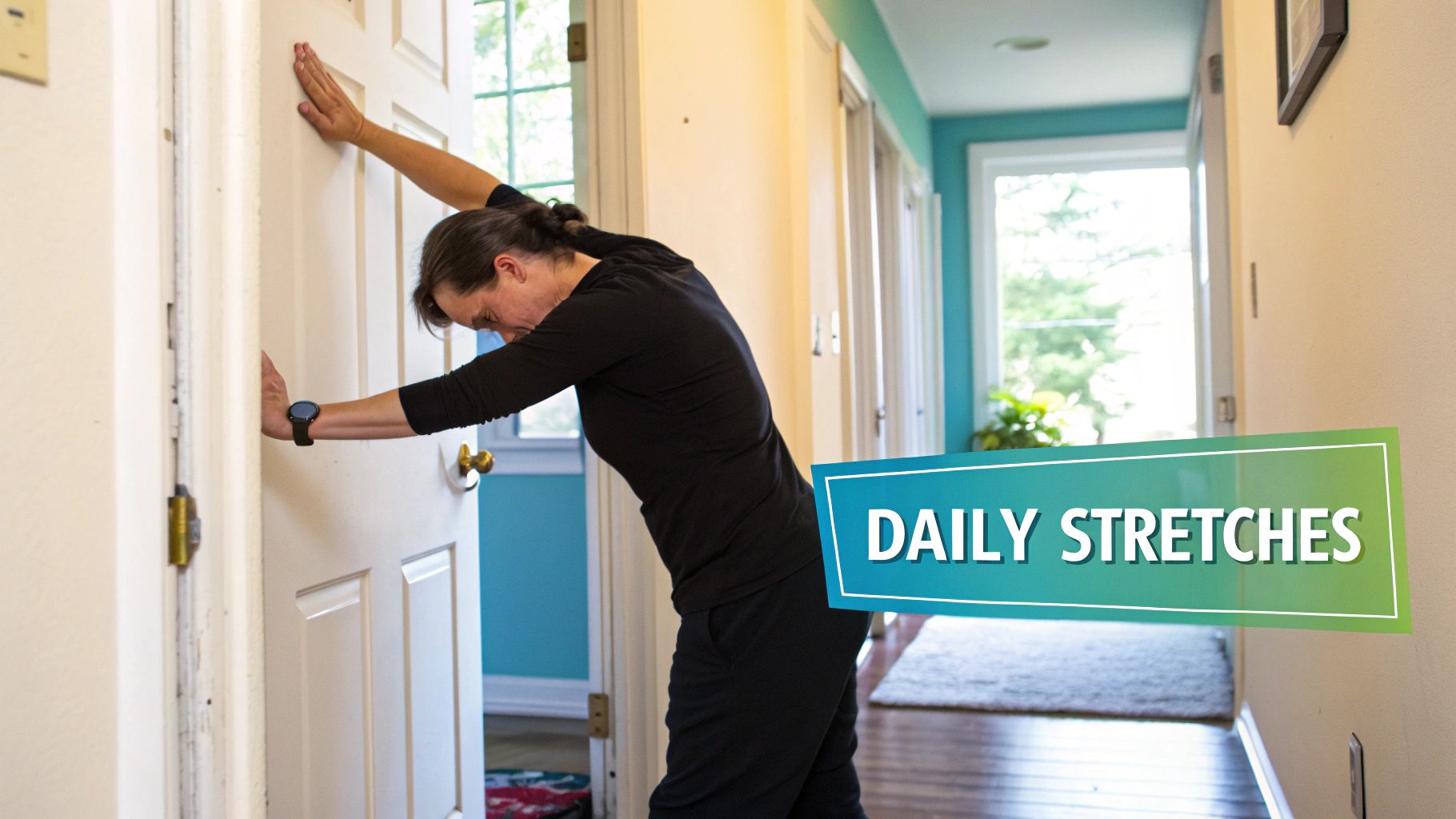
Gentle Stretches To Release Shoulder Tension
It's so important to approach stretching with a gentle mindset. You're looking for a mild pulling sensation, never a sharp pain. Hold each stretch for about 20-30 seconds and really focus on your breathing—deep, slow breaths tell your muscles it's safe to let go.
Here are a couple of my favourite, highly effective stretches for that tricky area under and around your left shoulder blade:
Doorway Chest Stretch: So much of our upper back pain comes from poor posture, especially when we let our shoulders round forward. This stretch is the perfect antidote because it opens up the chest muscles (your pecs), which immediately takes a load of strain off your back. * Stand in an open doorway. * Place your forearms on the frame with your elbows just a bit below shoulder height, like you're making a "goalpost" shape. * Gently step forward with one foot until you feel a nice, easy stretch across your chest and the front of your shoulders. * Hold it right there, breathe, and then slowly step back. Aim to do this 2-3 times.
Cat-Cow Pose: This is a classic for a reason. It's fantastic for getting your entire spine moving, which can help ease tension that travels up into the shoulder blade area. * Get on your hands and knees, making sure your wrists are right under your shoulders and your knees are under your hips. * As you breathe in (the "Cow" part), let your belly drop towards the floor and look up slightly, creating a gentle arch in your back. * As you breathe out (the "Cat" part), press the floor away with your hands, round your spine up to the ceiling, and tuck your chin towards your chest. * Just flow between these two positions for 8-10 slow, mindful repetitions.
If you're looking for more ways to tackle discomfort from being seated for long periods, you might find our guide on 3 tips to relieve back and shoulder pain really helpful.
Beyond Stretching: Powerful Self-Care Tactics
While stretching is a big piece of the puzzle, other at-home strategies can provide huge relief and work hand-in-hand with your professional massage therapy.
It's also worth noting that sometimes, that pain can be a sign of something more specific. For instance, a condition like frozen shoulder can cause a sharp, stabbing pain under the left shoulder blade and really limit your movement. While the general population has a 3-5% lifetime risk, that number jumps to a staggering 20% for people with diabetes. The good news? Research shows about 70% of cases can recover with consistent care at home, which really shows how powerful self-management can be.
Here are a few simple techniques to add to your daily routine, which can make a world of difference between your massage appointments.
Effective Self-Care Techniques for Shoulder Blade Discomfort
This table offers a quick guide to simple, safe remedies and stretches you can do at home to manage pain and stiffness.
Technique | Primary Benefit | Recommended Frequency |
|---|---|---|
Self-Massage (Tennis Ball) | Targets specific knots (trigger points) for focused relief | Daily, or as needed for 1-2 minutes per spot |
Heat Application | Soothes general muscle stiffness and improves circulation | 15-20 minutes, 1-2 times per day, especially for chronic aches |
Mindful Ergonomics | Reduces cumulative strain from daily activities and posture | Continuously, with regular posture checks throughout the day |
Doorway Chest Stretch | Counteracts slouching and opens up tight pectoral muscles | 1-2 times daily, holding for 20-30 seconds |
Cat-Cow Pose | Improves overall spinal mobility and releases tension | Daily, for 8-10 slow repetitions |
Integrating even one or two of these into your day can significantly improve your comfort and extend the benefits of your massage therapy.
Self-Myofascial Release with a Tennis Ball: This is like giving yourself a mini trigger-point massage. Just stand with your back to a wall, pop a tennis ball between the wall and the sore spot near your shoulder blade, and gently lean into it. Roll the ball around slowly to find those tender points, then hold the pressure for 20-30 seconds while you take some deep breaths.
Strategic Use of Heat: Applying a warm compress or heating pad to the area for 15-20 minutes is a wonderful way to soothe sore, tight muscles. The heat boosts circulation, helping the tissues relax and easing the sensation of pain. It’s especially good for those chronic, dull aches.
Mindful Ergonomic Adjustments: Take a look at your daily environment. If you’re at a desk, is your monitor at eye level? Does your chair support the natural curve of your lower back? Even in the car, adjusting your seat so you’re sitting upright instead of reaching for the wheel can make a huge difference in the daily strain on your upper back.
It's Time to Feel Better
Living with that nagging pain under your left shoulder blade doesn't have to be your new normal. Taking that first step toward feeling better is often the hardest part, but it's also the most important. A professional Registered Massage Therapist can help you get to the bottom of what's causing the ache and, more importantly, help you find lasting relief.
For so many people, this kind of pain is a direct result of our daily routines and habits building up over time. It’s surprisingly common, too. Workers' compensation data shows that shoulder impingement and strains—the very issues that often send pain radiating to the left shoulder blade—account for 10-11% of all claim costs. These are often tied to repetitive movements, like reaching or lifting an arm. If you're curious about the mechanics behind it, you can read more about these shoulder disorder findings.
Your Path to Lasting Relief
At Still Waters Healing Massage, Taylor, our professional male RMT, focuses on one thing: providing thoughtful, personalized therapeutic care that works. He makes it easy by bringing his expert mobile massage service right to your door in Brampton, Toronto, Etobicoke, Oakville, Caledon, Orangeville, Mississauga, Milton, Halton, and Guelph. No traffic, no stress.
Investing in your health is the most important decision you can make. Professional, targeted massage therapy isn't just about temporary comfort; it's about restoring your body's function and reclaiming your quality of life.
Whether the right approach for you is a Deep Tissue Massage, Myofascial Release, or a gentle Geriatric Massage, your treatment will be designed specifically for your needs.
There’s no reason to wait another day. Book your in-home massage appointment online and start your journey back to comfort and mobility today.
Your Questions Answered
If you're considering massage therapy for that nagging pain under your left shoulder blade, it’s completely normal to have a few questions. Let's walk through some of the most common ones so you can feel comfortable and prepared for your first session.
How Quickly Will I Feel Better After a Massage?
That's the million-dollar question, isn't it? While many people feel a noticeable difference and a sense of relief after their very first massage, the exact timeline really depends on what's causing the pain.
If the discomfort is from something recent, like a weekend of gardening, you might find one session does the trick. But for more stubborn, chronic pain linked to years of desk work or a repetitive strain injury, a series of treatments is usually the best path to achieving real, lasting results. Think of it like this: it took time for that tension to build up, so it will take a bit of time to gently and effectively release it. During your initial visit, we'll discuss a personalized plan that makes sense for you.
Is Deep Tissue Massage Supposed to Hurt?
Not at all. While deep tissue work involves firm, targeted pressure to get to those deeper layers of muscle, it should never feel sharp or unbearable. Many clients describe the sensation as a "good hurt"—that satisfying feeling when a therapist finds the exact spot and you can feel the tension begin to melt away.
A good therapist communicates with you constantly, checking in to make sure the pressure is just right. The goal is always therapeutic release, not an endurance test. You are always in control of the session.
Remember, effective therapeutic massage is a dialogue between client and therapist. Open communication ensures that the pressure is productive, helping to release stubborn knots without causing undue discomfort or tissue damage.
What’s an In-Home Mobile Massage Appointment Actually Like?
It’s all about bringing professional, clinical-level care right into the comfort of your own home. It’s a surprisingly seamless experience.
Taylor arrives with everything needed: a professional massage table, fresh, clean linens, and all the necessary supplies for techniques like Swedish massage, Cupping therapy, or Myofascial release. After a quick chat to discuss your needs, the treatment begins. You are always professionally draped with secure linens, and only the specific area being worked on is uncovered.
The biggest benefit? No travel. You don't have to navigate traffic or head back out into the cold after your session. It’s an incredibly convenient and stress-free way to get the care you need in Brampton, Mississauga, Oakville, and the surrounding areas, allowing you to simply relax in your own space afterwards.
Ready to finally get to the bottom of that shoulder blade pain? Stillwaters Healing & Massage brings professional, targeted RMT services directly to you.


